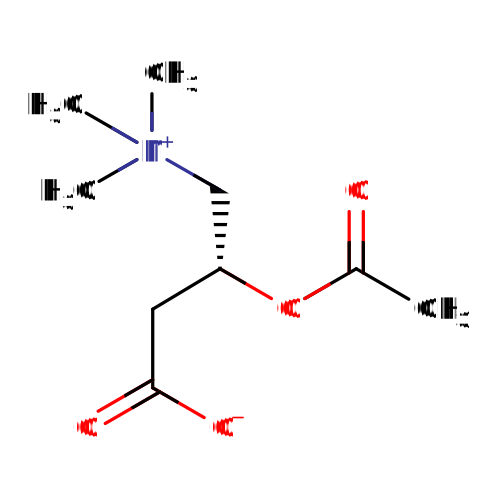
L-Acetylcarnitine, also known as alcar or branigen, belongs to the class of organic compounds known as acyl carnitines. These are organic compounds containing a fatty acid with the carboxylic acid attached to carnitine through an ester bond. Thus, L-acetylcarnitine is considered to be a fatty ester lipid molecule. L-Acetylcarnitine exists as a solid, very hydrophobic, practically insoluble (in water), and relatively neutral molecule. L-Acetylcarnitine exists in all living species, ranging from bacteria to humans. L-Acetylcarnitine participates in a number of enzymatic reactions, within cattle. In particular, L-Acetylcarnitine and coenzyme A can be biosynthesized from acetyl-CoA and L-carnitine through the action of the enzyme carnitine O-acetyltransferase. In addition, L-Acetylcarnitine and L-carnitine can be converted into acetyl-CoA and coenzyme A; which is catalyzed by the enzyme carnitine O-acetyltransferase. In cattle, L-acetylcarnitine is involved in the metabolic pathway called the Beta oxidation OF very long chain fatty acids pathway. L-Acetylcarnitine has been found to be associated with several diseases known as colorectal cancer, crohn's disease, and 3-hydroxyacyl-coa dehydrogenase deficiency; also l-acetylcarnitine has been linked to several inborn metabolic disorders including very long chain acyl-coa dehydrogenase deficiency and 3-methyl-crotonyl-glycinuria.
belongs to the class of organic compounds known as acyl carnitines. These are organic compounds containing a fatty acid with the carboxylic acid attached to carnitine through an ester bond.
Gu, Heng-da; Shi, Shuang; Yang, Ying; Shi, Zhao-xin; Yu, Zhan-long. Synthesis of acetyl-L-carnitine by direct acylation method. Shenyang Huagong Xueyuan Xuebao (2006), 20(2), 154-155, 160.
Material Safety Data Sheet (MSDS)
Not Available
General References
Lu J, Antunes Fernandes E, Paez Cano AE, Vinitwatanakhun J, Boeren S, van Hooijdonk T, van Knegsel A, Vervoort J, Hettinga KA: Changes in milk proteome and metabolome associated with dry period length, energy balance, and lactation stage in postparturient dairy cows. J Proteome Res. 2013 Jul 5;12(7):3288-96. doi: 10.1021/pr4001306. Epub 2013 Jun 5. [PubMed:23738862 ]
O'Callaghan TF, Vazquez-Fresno R, Serra-Cayuela A, Dong E, Mandal R, Hennessy D, McAuliffe S, Dillon P, Wishart DS, Stanton C, Ross RP: Pasture Feeding Changes the Bovine Rumen and Milk Metabolome. Metabolites. 2018 Apr 6;8(2). pii: metabo8020027. doi: 10.3390/metabo8020027. [PubMed:29642378 ]
Kurt J. Boudonck, Matthew W. Mitchell, Jacob Wulff and John A. Ryals (2009). Kurt J. Boudonck, Matthew W. Mitchell, Jacob Wulff and John A. Ryals. Characterization of the biochemical variability of bovine milk using metabolomics. Metabolomics (2009) 5:375?386. Metabolomics.
A. Foroutan et al. (2019). A. Foroutan et al. The Chemical Composition of Commercial Cow's Milk (in preparation). Journal of Agricultural and Food Chemistry.