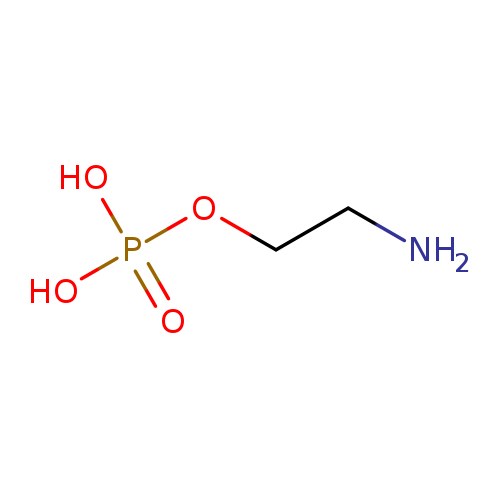
O-Phosphoethanolamine, also known as colamine phosphoric acid or ethanolamine phosphate, belongs to the class of organic compounds known as phosphoethanolamines. Phosphoethanolamines are compounds containing a phosphate linked to the second carbon of an ethanolamine. O-Phosphoethanolamine exists as a solid, possibly soluble (in water), and a very strong basic compound (based on its pKa) molecule. O-Phosphoethanolamine exists in all living species, ranging from bacteria to humans. O-Phosphoethanolamine is a potentially toxic compound.
belongs to the class of organic compounds known as phosphoethanolamines. Phosphoethanolamines are compounds containing a phosphate linked to the second carbon of an ethanolamine.
PLS-DA of the serum metabolite profiles derived from both negative and positive ionisation modes m/z exhibited some discrimination between MAP challenged and control cattle, albeit with overlapping of 95 confidence intervals, PLS-DA models 24-months post MAP inoculation are shown in Fig. 1.
Written in the paper as “O-Phosphoethanolamine” and “serum”
Eleven metabolites had a positive relationship with the total area under the H.E.A.T. curve (in order of significance: phosphorylethanolamine, orotate, thymine, uridine, indole, glutathione disulfide, cytidine, pantothenate, uracil, ribose phosphate and 2-hydroxy-2-methylsuccinate), and one metabolite, cystine, had a negative relationship (P < 0.05; Figure 4).
Written in the paper as “phosphorylethanolamine” and “follicular fluid”
Detected in
Luteal Cells
A progesterone secreting cell in the corpus luteum. The large luteal cells develop from the granulosa cells. The small luteal cells develop from the theca cells.
In luteal cells, phospholipids, including phosphoethanolamine, have been shown to play a role in gonadotropin-receptor binding and receptor activity (Azhar et al. 1976).
Written in the paper as “phosphoethanolamine” and “luteal cells”
However, when this finding is coupled with the new finding highlighting a positive relationship of intrafollicular phosphoethanolamine with H.E.A.T. these outcomes are not only insightful but may be functionally relevant.
Written in the paper as “phosphoethanolamine” and “periovulatory follicular fluid”
The most abundant compounds in testis, in terms of umol per gram wet-weight were lactate (7.7 + 1.6 umol/g), creatine (7.6 + 1.9 umol/g), myo-inositol (7.2 + 1.2 umol/g), O-phosphoethanolamine (7 + 1.2 umol/g), and glutamate (3.3 + 0.7 umol/g), whereas the least abundant compound was spermidine (0.4 + 0.2 nmol/g).
Written in the paper as “O-phosphoethanolamine” and “testis”
Larger temporal changes were observed in MastitisPost vs. Control cows: the proportion of NEFA on total FA (NEFA ) increased stronger in MastitisPost vs. Control cows (+333 vs. +82 ; p = 0.02; Figure 3A), as summed signal intensities of NEFA (MastitisPost vs. Control cows: +338 vs. +89 ; Figure 3A) and summed signal intensities of LPC ( 59 vs. 39 ), PC ( 49 vs. 15 ), PE ( 24 vs. +5 ), and PI ( 26 vs. +36 ) changed in opposite directions; the change being significant only in MastitisPost cows.
Written in the paper as “phosphoethanolamine” and “Mastitis”
In luteal cells, phospholipids, including phosphoethanolamine, have been shown to play a role in gonadotropin-receptor binding and receptor activity (Azhar et al. 1976).
Written in the paper as “phosphoethanolamine” and “gonadotropin-receptor binding”
Involved in
phosphatidylcholine biosynthetic process GO:0006656
The chemical reactions and pathways resulting in the formation of phosphatidylcholines, any of a class of glycerophospholipids in which the phosphatidyl group is esterified to the hydroxyl group of choline.
Within the negative ionisation data, the abundance of metabolites involved in nucleotide metabolism (deoxyadenosine and uridine), the Krebs cycle (glyoxylic acid) and phosphatidylcholine biosynthesis (o-phosphoethanolamine) decreased within MAP challenged cattle.
Written in the paper as “o-phosphoethanolamine” and “phosphatidylcholine biosynthesis”
In luteal cells, phospholipids, including phosphoethanolamine, have been shown to play a role in gonadotropin-receptor binding and receptor activity (Azhar et al. 1976).
Written in the paper as “phosphoethanolamine” and “receptor activity”
Muller K; Schulz J; Oemus R Phosphoethanolamine--a substrate of alkaline phosphatase isolated from rat calvaria. Biomedica biochimica acta (1989), 48(8), 495-504.
Material Safety Data Sheet (MSDS)
Not Available
General References
Melzer N, Wittenburg D, Hartwig S, Jakubowski S, Kesting U, Willmitzer L, Lisec J, Reinsch N, Repsilber D: Investigating associations between milk metabolite profiles and milk traits of Holstein cows. J Dairy Sci. 2013 Mar;96(3):1521-34. doi: 10.3168/jds.2012-5743. [PubMed:23438684 ]
Mung D, Li L: Development of Chemical Isotope Labeling LC-MS for Milk Metabolomics: Comprehensive and Quantitative Profiling of the Amine/Phenol Submetabolome. Anal Chem. 2017 Apr 18;89(8):4435-4443. doi: 10.1021/acs.analchem.6b03737. Epub 2017 Mar 28. [PubMed:28306241 ]
Mung D, Li L: Applying quantitative metabolomics based on chemical isotope labeling LC-MS for detecting potential milk adulterant in human milk. Anal Chim Acta. 2018 Feb 25;1001:78-85. doi: 10.1016/j.aca.2017.11.019. Epub 2017 Nov 14. [PubMed:29291809 ]