| Record Information |
|---|
| Version | 1.0 |
|---|
| Creation Date | 2016-09-30 22:43:50 UTC |
|---|
| Update Date | 2020-06-04 20:44:33 UTC |
|---|
| BMDB ID | BMDB0001302 |
|---|
| Secondary Accession Numbers | |
|---|
| Metabolite Identification |
|---|
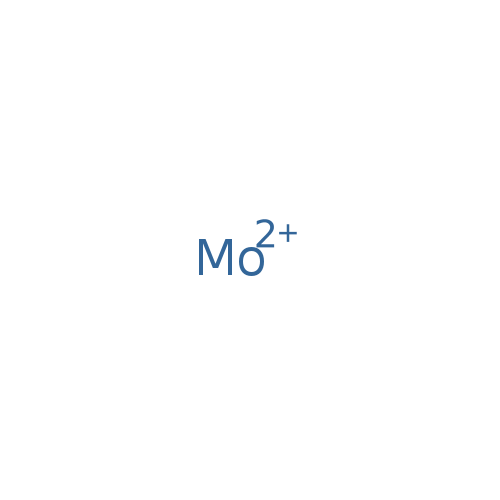
| Common Name | Molybdenum |
|---|
| Description | Molybdenum, also known as Mo, belongs to the class of inorganic compounds known as homogeneous transition metal compounds. These are inorganic compounds containing only metal atoms,with the largest atom being a transition metal atom. Molybdenum exists as a solid, possibly soluble (in water), and possibly neutral molecule. Molybdenum exists in all living organisms, ranging from bacteria to humans. In cattle, molybdenum is involved in the metabolic pathway called the caffeine metabolism pathway. Molybdenum is a potentially toxic compound. |
|---|
| Structure | |
|---|
| Synonyms | | Value | Source |
|---|
| Mo | HMDB | | Molybdaen | HMDB | | Molybdene | HMDB | | Molybdenum atom | HMDB | | Molybdenum elemental | HMDB | | Molybdenum insoluble compounds | HMDB | | Molybdenum metallic | HMDB |
|
|---|
| Chemical Formula | Mo |
|---|
| Average Molecular Weight | 95.94 |
|---|
| Monoisotopic Molecular Weight | 97.905407846 |
|---|
| IUPAC Name | molybdenum(2+) ion |
|---|
| Traditional Name | molybdenum(2+) ion |
|---|
| CAS Registry Number | 7439-98-7 |
|---|
| SMILES | [Mo++] |
|---|
| InChI Identifier | InChI=1S/Mo/q+2 |
|---|
| InChI Key | MMVYPOCJESWGTC-UHFFFAOYSA-N |
|---|
| Chemical Taxonomy |
|---|
| Description | belongs to the class of inorganic compounds known as homogeneous transition metal compounds. These are inorganic compounds containing only metal atoms,with the largest atom being a transition metal atom. |
|---|
| Kingdom | Inorganic compounds |
|---|
| Super Class | Homogeneous metal compounds |
|---|
| Class | Homogeneous transition metal compounds |
|---|
| Sub Class | Not Available |
|---|
| Direct Parent | Homogeneous transition metal compounds |
|---|
| Alternative Parents | Not Available |
|---|
| Substituents | - Homogeneous transition metal
|
|---|
| Molecular Framework | Not Available |
|---|
| External Descriptors | |
|---|
| Ontology |
|---|
| Status | Detected and Quantified |
|---|
| Origin | |
|---|
| Biofunction | Not Available |
|---|
| Application | Not Available |
|---|
| Cellular locations | |
|---|
| Physical Properties |
|---|
| State | Solid |
|---|
| Experimental Properties | | Property | Value | Reference |
|---|
| Melting Point | 2622 °C | Not Available | | Boiling Point | Not Available | Not Available | | Water Solubility | Not Available | Not Available | | LogP | Not Available | Not Available |
|
|---|
| Predicted Properties | |
|---|
| Spectra |
|---|
| Spectra | |
|---|
| Biological Properties |
|---|
| Cellular Locations | |
|---|
| Biospecimen Locations | - Blood
- Brain
- Liver
- Milk
- Ruminal Fluid
- Testis
|
|---|
| Pathways | |
|---|
| Normal Concentrations |
|---|
| |
| Brain | Expected but not Quantified | Not Quantified | Not Specified | Not Specified | Normal | | details | | Liver | Detected and Quantified | 3 +/- 1 nmol/g of tissue | Not Specified | Not Specified | Normal | | details | | Milk | Detected and Quantified | 0.41 uM | Not Specified | Not Specified | Normal | | details | | Milk | Detected and Quantified | 0.26 +/- 0.02 uM | Not Specified | Not Specified | Normal | | details | | Milk | Detected and Quantified | 0.25 +/- 0.01 uM | Not Specified | Not Specified | Normal | | details | | Milk | Detected and Quantified | 0.25 +/- 0.02 uM | Not Specified | Not Specified | Normal | | details | | Milk | Detected and Quantified | 0.154 +/- 0.00208 uM | Not Specified | Not Specified | Normal | | details | | Milk | Detected and Quantified | 0.29 +/- 0.01 uM | Not Specified | Not Specified | Normal | | details | | Milk | Detected and Quantified | 0.163 +/- 0.00104 uM | Not Specified | Not Specified | Normal | | details | | Milk | Detected and Quantified | 0.180 +/- 0.00208 uM | Not Specified | Not Specified | Normal | | details | | Milk | Detected and Quantified | 0.216 +/- 0.00938 uM | Not Specified | Not Specified | Normal | | details | | Milk | Detected and Quantified | 0.170 +/- 0.00417 uM | Not Specified | Not Specified | Normal | | details | | Milk | Detected and Quantified | 0.229 +/- 0.0104 uM | Not Specified | Not Specified | Normal | | details | | Milk | Detected and Quantified | 0.161 +/- 0.00417 uM | Not Specified | Not Specified | Normal | | details | | Milk | Detected and Quantified | 0.146 +/- 0.0208 uM | Not Specified | Not Specified | Normal | | details | | Milk | Detected and Quantified | 0.106 +/- 0.00730 uM | Not Specified | Not Specified | Normal | | details | | Milk | Detected and Quantified | 0.417 - 1.876 uM | Not Specified | Not Specified | Normal | | details | | Milk | Detected and Quantified | 0.108 - 0.111 uM | Not Specified | Not Specified | Normal | | details | | Ruminal Fluid | Detected and Quantified | 0.0187 +/- 0.008 uM | Not Specified | Not Specified | Normal | | details | | Testis | Detected and Quantified | 0.06 +/- 0.01 nmol/g of tissue | Not Specified | Not Specified | Normal | | details |
|
|---|
| Abnormal Concentrations |
|---|
| |
| Blood | Detected but not Quantified | Not Quantified | Not Specified | Not Specified | Fatal bovine respiratory disease | | details |
|
|---|
| External Links |
|---|
| HMDB ID | HMDB0001302 |
|---|
| DrugBank ID | Not Available |
|---|
| Phenol Explorer Compound ID | Not Available |
|---|
| FooDB ID | FDB003653 |
|---|
| KNApSAcK ID | Not Available |
|---|
| Chemspider ID | 161267 |
|---|
| KEGG Compound ID | C00150 |
|---|
| BioCyc ID | Not Available |
|---|
| BiGG ID | Not Available |
|---|
| Wikipedia Link | Molybdenum |
|---|
| METLIN ID | Not Available |
|---|
| PubChem Compound | 185498 |
|---|
| PDB ID | Not Available |
|---|
| ChEBI ID | 28685 |
|---|
| References |
|---|
| Synthesis Reference | Not Available |
|---|
| Material Safety Data Sheet (MSDS) | Not Available |
|---|
| General References | - Lopez-Garcia I, Vinas P, Romero-Romero R, Hernandez-Cordoba M: Liquid chromatography-electrothermal atomic absorption spectrometry for the separation and preconcentration of molybdenum in milk and infant formulas. Anal Chim Acta. 2007 Aug 6;597(2):187-94. doi: 10.1016/j.aca.2007.07.003. Epub 2007 Jul 5. [PubMed:17683729 ]
- Semaghiul Birghila, Simona Dobrinas, Gabriela Stanciu and Alina Soceanu (2008). Semaghiul Birghila, Simona Dobrinas, Gabriela Stanciu and Alina Soceanu. Determination of major and minor elements in milk through ICP-AES. Environmental Engineering and Management Journal. November/December 2008, Vol.7, No.6, 805-808. Environmental Engineering and Management Journal.
- Z. Dobrzański, R. Kołacz, H. Górecka, K. Chojnacka, A. Bartkowiak. (2005). Z. Dobrzański, R. Kołacz, H. Górecka, K. Chojnacka, A. Bartkowiak. 2005. The Content of Microelements and Trace Elements in Raw Milk from Cows in the Silesian Region. Pol. J. Environ. Stud. 14(5):685–689. Polish Journal of Environmental Studies.
- A. Foroutan et al. (2019). A. Foroutan et al. The Chemical Composition of Commercial Cow's Milk (in preparation). Journal of Agricultural and Food Chemistry.
- Patricia Cava-Montesinos, M. Luisa Cervera Agustín Pastor Miguel de la Guardia (2005). Patricia Cava-Montesinos, M. Luisa Cervera Agustín Pastor Miguel de la Guardia. 2005. Room temperature acid sonication ICP-MS multielemental analysis of milk.Analytica Chimica Acta Volume 531, Issue 1, Pages 111-123. Analytica Chimica Acta.
|
|---|