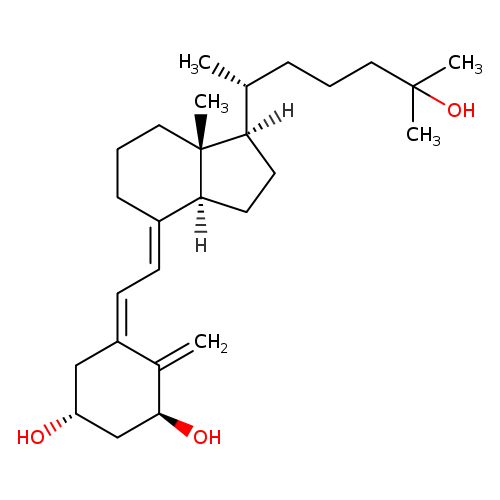
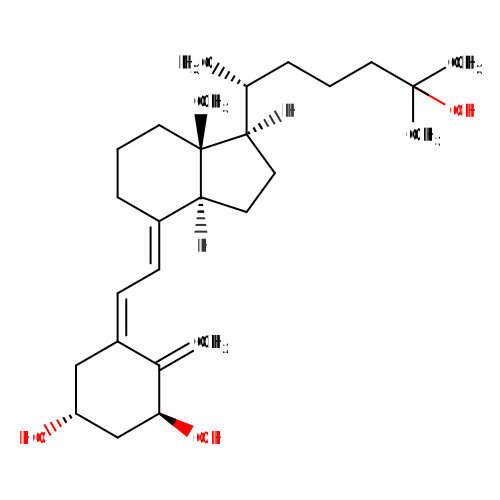
Calcitriol, also known as 1a,25(OH)2D3 or calcitriol-nefro, belongs to the class of organic compounds known as vitamin d and derivatives. Vitamin D and derivatives are compounds containing a secosteroid backbone, usually secoergostane or secocholestane. Thus, calcitriol is considered to be a secosteroid lipid molecule. Calcitriol is a drug which is used to treat vitamin d deficiency or insufficiency, refractory rickets (vitamin d resistant rickets), familial hypophosphatemia and hypoparathyroidism, and in the management of hypocalcemia and renal osteodystrophy in patients with chronic renal failure undergoing dialysis. also used in conjunction with calcium in the management and prevention of primary or corticosteroid-induced osteoporosis. Calcitriol exists as a solid, very hydrophobic, practically insoluble (in water), and relatively neutral molecule. Calcitriol is a potentially toxic compound.
belongs to the class of organic compounds known as vitamin d and derivatives. Vitamin D and derivatives are compounds containing a secosteroid backbone, usually secoergostane or secocholestane.
In the kidney, 25(OH)D is further metabolized into the active hormone 1,25-dihydroxyvitamin D (see Additional file 3: Figure S1), with strictly regulated levels.
Written in the paper as “1,25-dihydroxyvitamin D” and “kidney”
The active form of vitamin D3, the 1,25-dihydroxycholecalciferol [1,25(OH)2D3] or calcitriol, is formed from vitamin D3 through two independent hydroxylation reactions, in the liver and in the kidneys; vitamin D2 is activated in a similar way.
Written in the paper as “1,25-dihydroxycholecalciferol” and “kidneys”
The conformation of the PTH receptor is more sensitive to PTH at a lower pH and the kidneys have higher reabsorption of calcium from the glomerular filtrate and function better at converting 25-hydroxyvitamin D into 1,25-dihydroxyvitamin D, the active form of vitamin D, which is required for intestinal uptake of calcium (Goff 2008).
Written in the paper as “1,25-dihydroxyvitamin D” and “kidneys”
Even though they all remained above physiological plasma levels (1,25D: 0.05-0.12 nM; 25D: 20 90 nM; D: 4 nM, Tiraboschi et al., 2023), substantially supraphysiological concentrations posing a risk of hypercalcemia were avoided.
Written in the paper as “1,25-dihydroxyvitamin D3” and “plasma”
Plasma parathyroid hormone (PTH), 1,25-dihydroxyvitamin D3 (1,25(OH)2D3), calcitonin (CT), carboxy-terminal cross-linked telopeptide of type collagen (CTX- ), and osteocalcin (OC) concentrations were analyzed using commercial ELISA kits using the following methods (Beijing Gersion Biotechnology Co.)32,33.
Written in the paper as “1,25-dihydroxyvitamin D3” and “plasma”
The active form of vitamin D3, the 1,25-dihydroxycholecalciferol [1,25(OH)2D3] or calcitriol, is formed from vitamin D3 through two independent hydroxylation reactions, in the liver and in the kidneys; vitamin D2 is activated in a similar way.
Written in the paper as “1,25-dihydroxycholecalciferol” and “liver”
In relation to nursing infants, cow s milk contains similar concentrations of vitamin D3 and 1,25 (OH) vitamin D3 (the active form of vitamin D3) compared to breast milk and can cause the same desired effect [40].
Written in the paper as “1,25 (OH) vitamin D3” and “milk”
A phosphorus metabolism disease that is characterized by hypophosphatemia and the symptoms of osteomalacia including bone pain, skeletal deformities and osteoarthritis.
Circulating ionized calcium concentrations were consistently higher in the low-phosphorus group, accompanied by elevated levels of 1,25(OH)2D3, indicating activation of endocrine mechanisms supporting calcium homeostasis.
Written in the paper as “1,25(OH)2D3” and “hypophosphatemia”
The vitamin D metabolite, 1,25-dihydroxy vitamin D3 [1,25-(OH)2D3], parathyroid hormone (PTH), and fibroblast growth factor 23 (FGF23) are prominent hormones controlling the Ca2+ balance [30,31].
Written in the paper as “1,25-dihydroxy vitamin D3” and “Ca2+ balance”
Circulating ionized calcium concentrations were consistently higher in the low-phosphorus group, accompanied by elevated levels of 1,25(OH)2D3, indicating activation of endocrine mechanisms supporting calcium homeostasis.
Written in the paper as “1,25(OH)2D3” and “calcium homeostasis”
Consistent with established physiological models, cows under hypophosphatemia exhibited elevated circulating 1,25-dihydroxyvitamin D3 and parathyroid hormone concentrations, indicative of active calcium homeostasis maintenance during the peripartum period44.
Written in the paper as “1,25-dihydroxyvitamin D3” and “calcium homeostasis maintenance”
The chemical reactions and pathways resulting in the formation of nitric oxide, nitrogen monoxide (NO), a colorless gas only slightly soluble in water.
Monocyte derived macrophages infected with Mycobacterium bovis (M. bovis) and treated with 1,25(OH)2D3 enhanced nitric oxide production and its corresponding NOS2 gene expression (Garc a-Barragan et al., 2018).
Written in the paper as “1,25(OH)2D3” and “nitric oxide production”
1,25(OH)2D3 has recently been shown to induce nitric oxide production along with upregulating NOS2 expression in macrophages from healthy cattle that have underwent in vitro infection with M. bovis [193].
Written in the paper as “1,25(OH)2D3” and “nitric oxide production”
Human promyelocytic cell line HL-60 has also reported upregulation of nitric oxide production, NOS2 expression, and a resulting inhibition of intracellular M. tb growth following treatment with 1,25(OH)2D3.
Written in the paper as “1,25(OH)2D3” and “nitric oxide production”
Curiously, 1,25(OH)2D3 significantly upregulated nitrite production, measured as an indicator of iNOS activity, in the activated PBMC-MDM co-cultures from cows with subclinical and clinical paratuberculosis [170].
Written in the paper as “1,25(OH)2D3” and “nitrite production”
The appearance of a cytokine due to biosynthesis or secretion following a cellular stimulus, resulting in an increase in its intracellular or extracellular levels.
Additionally, MDMs from clinical cows treated with either 25(OH)D3 or 1,25(OH)2D3 resulted in reduced IL-6 secretion (P < 0.01 and P < 0.001, respectively).
Written in the paper as “1,25(OH)2D3” and “IL-6 secretion”
1,25(OH)2D3 treatment played a key role in upregulating secretion of pro-inflammatory cytokines IL-1β and IL-12 while downregulating IL-10, IL-6, and IFN-γ.
Written in the paper as “1,25(OH)2D3” and “secretion of pro-inflammatory cytokines”
Evidence of 25(OH)D3 conversion to 1,25(OH)2D3 was first shown in macrophages from humans suffering from sarcoidosis [164] and is shown not to be regulated by parathyroid hormone and calcium [165].
Written in the paper as “1,25(OH)2D3” and “25(OH)D3 conversion to 1,25(OH)2D3”
1,25(OH)2D3 facilitates bone growth and remodeling by stimulating differentiation and maturation of osteoblasts and osteoclasts, while remineralization is downregulated by high phosphate and osteopontin levels [161].
Written in the paper as “1,25(OH)2D3” and “bone growth”
The continuous turnover of bone matrix and mineral that involves first, an increase in resorption (osteoclastic activity) and later, reactive bone formation (osteoblastic activity). The process of bone remodeling takes place in the adult skeleton at discrete foci. The process ensures the mechanical integrity of the skeleton throughout life and plays an important role in calcium homeostasis. An imbalance in the regulation of bone resorption and bone formation results in many of the metabolic bone diseases, such as osteoporosis.
1,25(OH)2D3 facilitates bone growth and remodeling by stimulating differentiation and maturation of osteoblasts and osteoclasts, while remineralization is downregulated by high phosphate and osteopontin levels [161].
Written in the paper as “1,25(OH)2D3” and “remodeling”
The process in which specialized cells known as osteoclasts degrade the organic and inorganic portions of bone, and endocytose and transport the degradation products.
1,25(OH)2D3 together with parathyroid hormone also facilitates demineralization of bone to release stored calcium by increasing activity of osteoclasts [162].
Written in the paper as “1,25(OH)2D3” and “demineralization of bone”
When calcium levels are insufficient, bioactive 1,25(OH)2D3 facilitates upregulation of calcium transport mechanisms to increase calcium and phosphate absorption by the intestine and renal tubule cells [126].
Written in the paper as “1,25(OH)2D3” and “calcium and phosphate absorption”
When calcium levels are insufficient, bioactive 1,25(OH)2D3 facilitates upregulation of calcium transport mechanisms to increase calcium and phosphate absorption by the intestine and renal tubule cells [126].
Written in the paper as “1,25(OH)2D3” and “calcium transport mechanisms”
Produced by
conversion of 25(our experiment with 1,25)D3 to 1,25-dihydroxyvitamin D3 [1,25(our experiment with 1,25)2D3]
For example, intramammary LPS challenge increased transcripts for 1a-hydroxylase (CYP27B1), which catalyzes conversion of 25(OH)D3 to 1,25-dihydroxyvitamin D3 [1,25(OH)2D3], and the vitamin D receptor (VDR) in macrophages and neutrophils in the mammary gland (Merriman et al., 2018).
Written in the paper as “1,25-dihydroxyvitamin D3” and “conversion of 25(our experiment with 1,25)D3 to 1,25-dihydroxyvitamin D3 [1,25(our experiment with 1,25)2D3]”
Activates
differentiation and maturation of osteoblasts and osteoclasts
1,25(OH)2D3 facilitates bone growth and remodeling by stimulating differentiation and maturation of osteoblasts and osteoclasts, while remineralization is downregulated by high phosphate and osteopontin levels [161].
Written in the paper as “1,25(OH)2D3” and “differentiation and maturation of osteoblasts and osteoclasts”
The process in which a relatively unspecialized cell acquires specialized features of an adipocyte, an animal connective tissue cell specialized for the synthesis and storage of fat.
The 1,25-dihydroxy vitamin D3 (1,25 (OH)2 D3) is an active form of vitamin D and has been shown to restrict the adipogenesis in the bone marrow of SAM-P/6 mice associated with decreased expression of PPAR-g2 [152].
Written in the paper as “1,25-dihydroxy vitamin D3” and “adipogenesis”
Results from this study demonstrate that vitamin D3 compounds, but mainly 1,25(OH)2D3, modulate both pro- and anti-inflammatory immune responses in dairy cattle infected with MAP, impacting the bacterial viability within the macrophage.
Written in the paper as “1,25(OH)2D3” and “immune responses”
Cells of the immune system have the capability to convert circulating 25-dihydroxyvitamin D3 (25(OH)D3) to its bioactive form, 1a-dihydroxyvitamin D3 (1,25(OH)2D3) (Adams et al., 1983; Nelson et al., 2010b), which in turn modulates immune system signaling during infection.
Written in the paper as “1,25(OH)2D3” and “immune system signaling”
The conformation of the PTH receptor is more sensitive to PTH at a lower pH and the kidneys have higher reabsorption of calcium from the glomerular filtrate and function better at converting 25-hydroxyvitamin D into 1,25-dihydroxyvitamin D, the active form of vitamin D, which is required for intestinal uptake of calcium (Goff 2008).
Written in the paper as “1,25-dihydroxyvitamin D” and “intestinal uptake of calcium”
A developmental process, independent of morphogenetic (shape) change, that is required for an oocyte to attain its fully functional state. Oocyte maturation commences after reinitiation of meiosis commonly starting with germinal vesicle breakdown, and continues up to the second meiotic arrest prior to fertilization.
A vesicle-mediated transport process that results in the engulfment of external particulate material by phagocytes and their delivery to the lysosome. The particles are initially contained within phagocytic vacuoles (phagosomes), which then fuse with primary lysosomes to effect digestion of the particles.
Additional pro-inflammatory responses following 1,25(OH)2D3 treatment include increased IFNG expression in subclinical and clinical cow cell cultures, although trends for IFN-g protein expression were inconsistent with this pattern.
Written in the paper as “1,25(OH)2D3” and “pro-inflammatory responses”
The appearance of interferon-gamma due to biosynthesis or secretion following a cellular stimulus, resulting in an increase in its intracellular or extracellular levels. Interferon-gamma is also known as type II interferon.
Sperm Viability showed positive correlations with nonadecanoic acid (rs = 0.423, P < 0.05) and 1-monopalmitin (rs = 0.387, P < 0.05), and a negative correlation with calcitriol (rs = 0.403, P < 0.05).
Written in the paper as “calcitriol” and “Sperm Viability”
Originally referring to an endogenous compound that is formed in specialized organ or group of cells and carried to another organ or group of cells, in the same organism, upon which it has a specific regulatory function, the term is now commonly used to include non-endogenous, semi-synthetic and fully synthetic analogues of such compounds.
In the kidney, 25(OH)D is further metabolized into the active hormone 1,25-dihydroxyvitamin D (see Additional file 3: Figure S1), with strictly regulated levels.
Written in the paper as “1,25-dihydroxyvitamin D” and “active hormone”
Hollis BW, Roos BA, Draper HH, Lambert PW: Vitamin D and its metabolites in human and bovine milk. J Nutr. 1981 Jul;111(7):1240-8. doi: 10.1093/jn/111.7.1240. [PubMed:6788913 ]
Nuclear receptor for calcitriol, the active form of vitamin D3 which mediates the action of this vitamin on cells (By similarity). Enters the nucleus upon vitamin D3 binding where it forms heterodimers with the retinoid X receptor/RXR (By similarity). The VDR-RXR heterodimers bind to specific response elements on DNA and activate the transcription of vitamin D3-responsive target genes (By similarity). Plays a central role in calcium homeostasis (By similarity).