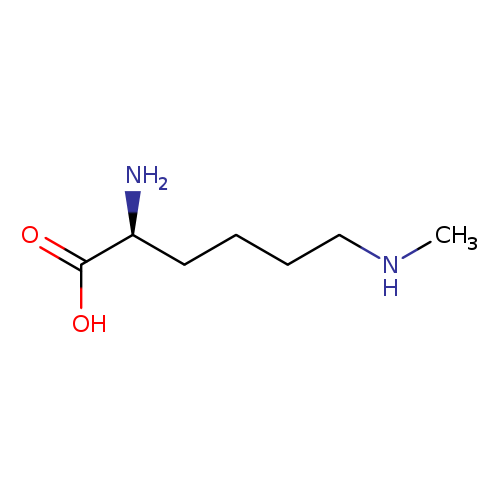
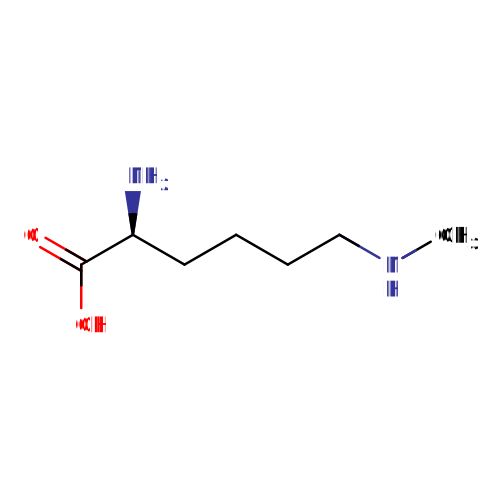
N(6)-Methyllysine, also known as N-methyl-L-lysine or melys, belongs to the class of organic compounds known as l-alpha-amino acids. These are alpha amino acids which have the L-configuration of the alpha-carbon atom. Based on a literature review a significant number of articles have been published on N(6)-Methyllysine.
belongs to the class of organic compounds known as l-alpha-amino acids. These are alpha amino acids which have the L-configuration of the alpha-carbon atom.
Through untargeted metabolomic profiling, we identified consistent alterations in specific metabolites such as digalacturonic acid, N-e-methyl-L-lysine, ropinirole, and acetylcarnitine across serum, milk, feces, and rumen fluid.
Written in the paper as “N-e-methyl-L-lysine” and “serum”
Through untargeted metabolomic profiling, we identified consistent alterations in specific metabolites such as digalacturonic acid, N-e-methyl-L-lysine, ropinirole, and acetylcarnitine across serum, milk, feces, and rumen fluid.
Written in the paper as “N-e-methyl-L-lysine” and “feces”
Through untargeted metabolomic profiling, we identified consistent alterations in specific metabolites such as digalacturonic acid, N-e-methyl-L-lysine, ropinirole, and acetylcarnitine across serum, milk, feces, and rumen fluid.
Written in the paper as “N-e-methyl-L-lysine” and “milk”
Through untargeted metabolomic profiling, we identified consistent alterations in specific metabolites such as digalacturonic acid, N-e-methyl-L-lysine, ropinirole, and acetylcarnitine across serum, milk, feces, and rumen fluid.
Written in the paper as “N-e-methyl-L-lysine” and “rumen fluid”
The results showed that the abundance of glycylleucine, L-3-cyanoalanine, 3-methyl-L-tyrosine, 2-(Methylamino)benzoic acid, N(6)-methyllysine, and Gamma-tocotrienol etc. in the feces of cows in CON group were markedly higher than those in SM group.
Written in the paper as “N(6)-methyllysine” and “subclinical mastitis”
Our findings reveal significant alterations in hematological and biochemical parameters, with key biomarkers such as digalacturonic acid and N-ε-methyl-L-lysine indicating systemic metabolic and immune dysregulation.
Written in the paper as “N-ε-methyl-L-lysine” and “Subclinical mastitis”
Our study also revealed several interesting and potential biomarker metabolites characteristic of repeat breeder cows, including N6-methyllysine, cis-5,8,11,14,17-eicosapentaenoic acid (EPA), and homocitrulline (L-citrulline).
Written in the paper as “N6-methyllysine” and “repeat breeder”
The immediate defensive reaction (by vertebrate tissue) to infection or injury caused by chemical or physical agents. The process is characterized by local vasodilation, extravasation of plasma into intercellular spaces and accumulation of white blood cells and macrophages.
N-e-methyl-L-lysine, in particular, emerged as a robust candidate due to its consistent dysregulation, aligning with its known role in immune modulation and inflammation.
Written in the paper as “N-e-methyl-L-lysine” and “inflammation”
Okedoyin et al. [51] found that N(6)-methyllysine, a product of lysine methylation, was significantly higher in an EOB containing anise, clove, oregano, and peppermint, compared to the control group.
Written in the paper as “N(6)-methyllysine” and “lysine methylation”
N-e-methyl-L-lysine, in particular, emerged as a robust candidate due to its consistent dysregulation, aligning with its known role in immune modulation and inflammation.
Written in the paper as “N-e-methyl-L-lysine” and “immune modulation”
Sidney et al. [52] observed that less-efficiently fed cattle had lower levels of N(6)-methyllysine in their stomach fluid, which was associated with poorer growth performance.
Written in the paper as “N(6)-methyllysine” and “growth performance”
Benoiton, Leo. Amino acids and peptides. II. Synthesis of e-N-methyl-L-lysine and related compounds. Canadian Journal of Chemistry (1964), 42(9), 2043-7.