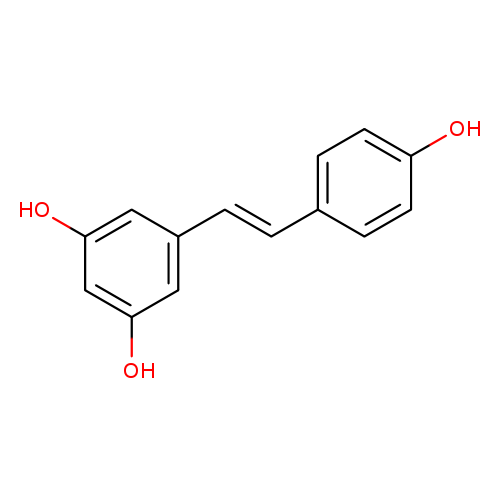
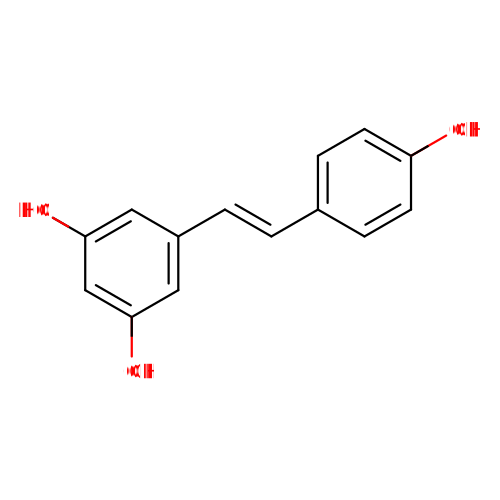
Resveratrol, also known as trans-resveratrol or SRT-501, belongs to the class of organic compounds known as stilbenes. These are organic compounds containing a 1,2-diphenylethylene moiety. Stilbenes (C6-C2-C6 ) are derived from the common phenylpropene (C6-C3) skeleton building block. The introduction of one or more hydroxyl groups to a phenyl ring lead to stilbenoids. Thus, resveratrol is considered to be an aromatic polyketide. Resveratrol exists in all living species, ranging from bacteria to plants to humans. Based on a literature review a significant number of articles have been published on Resveratrol.
belongs to the class of organic compounds known as stilbenes. These are organic compounds containing a 1,2-diphenylethylene moiety. Stilbenes (C6-C2-C6 ) are derived from the common phenylpropene (C6-C3) skeleton building block. The introduction of one or more hydroxyl groups to a phenyl ring lead to stilbenoids.
A programmed cell death process which begins when a cell receives an internal (e.g. DNA damage) or external signal (e.g. an extracellular death ligand), and proceeds through a series of biochemical events (signaling pathway phase) which trigger an execution phase. The execution phase is the last step of an apoptotic process, and is typically characterized by rounding-up of the cell, retraction of pseudopodes, reduction of cellular volume (pyknosis), chromatin condensation, nuclear fragmentation (karyorrhexis), plasma membrane blebbing and fragmentation of the cell into apoptotic bodies. When the execution phase is completed, the cell has died.
Further verification in LPS-treated BMECs revealed that the addition of 15 umol/L resveratrol, a nonflavonoid polyphenol compound, for 12 h significantly upregulated the expression of MFN1 and MFN2 mRNA, downregulated the expression of Drp1 mRNA, and inhibited apoptosis induced by the B-cell lymphoma-2 (Bcl-2) protein family member Bcl-2-associated X protein (Bax) and caspase-3 in BMECs [61].
Written in the paper as “resveratrol” and “apoptosis”
For instance, quercetin [78], curcurmin [79], ellagic acid [80], epigallocatechin-3-gallate [81] and resveratrol [82] were found to induce the critical cell cycle regulator p53 and, subsequently, cell cycle arrest and apoptosis in different cancer cells.
Written in the paper as “resveratrol” and “apoptosis”
Oral administration of resveratrol to mice at 30, 60, or 120 mg/kg for 10 weeks or in vitro administration to MAC-T cells at 100 uM for 24 h alleviated mitochondrial damage induced by high levels of nonesterified fatty acid stress, including restoration of the MMP, reduced mitochondrial swelling, increased ATP production, and rebalancing of NAD+/NADH levels.
Written in the paper as “resveratrol” and “adenosine triphosphate production”
This compound can activate mitophagy through AMPK activation and reduce the production of mtROS, IL-1b and NLRP3, thus exerting anti-inflammatory and antioxidant effects in various disease cell models [39].
Written in the paper as “Resveratrol” and “AMP-activated protein kinase activation”
For instance, quercetin [78], curcurmin [79], ellagic acid [80], epigallocatechin-3-gallate [81] and resveratrol [82] were found to induce the critical cell cycle regulator p53 and, subsequently, cell cycle arrest and apoptosis in different cancer cells.
Written in the paper as “resveratrol” and “cell cycle arrest”
Resveratrol also induce various chemical modifications, such as oxidation, dihydroxylation, and demethylation, enhancing the ability of BCG to induce trained immunity 161,162.
Written in the paper as “Resveratrol” and “demethylation”
The detoxification of reactive oxygen species by resveratrol was proven through stimulation of several antioxidant defense genes such as heme oxygenase 1 (HO-1), cysteine/glutamate transporter, thioredoxin reductase 1 (TXNRD1), and NAD(P)H quinone dehydrogenase 1, which were up-regulated by activation of nuclear factor erythroid 2.
Written in the paper as “Resveratrol” and “detoxification of reactive oxygen species”
Resveratrol also induce various chemical modifications, such as oxidation, dihydroxylation, and demethylation, enhancing the ability of BCG to induce trained immunity 161,162.
Written in the paper as “Resveratrol” and “dihydroxylation”
A MAPK cascade containing at least the ERK1 or ERK2 MAP kinases. It starts with the activation of a MAP3K, and the consecutive activation of a MPK2K and of ERK1 or ERK2. The cascade can also contain an additional tier: the upstream MAP4K. The kinases in each tier phosphorylate and activate the kinase in the downstream tier. The ERK1/ERK2 cascade is activated by mitogens, growth factors, G protein-coupled receptors, and results in cellular responses such as cell proliferation, cell differentiation and development.
For instance, exposure of a MAC-T line to resveratrol enhanced the expression of multiple antioxidant genes under normal and oxidative conditions via activation of Akt and ERK signalling pathways16.
Written in the paper as “resveratrol” and “ERK signalling pathways”
The removal of one or more electrons from a fatty acid, with or without the concomitant removal of a proton or protons, by reaction with an electron-accepting substance, by addition of oxygen or by removal of hydrogen.
Resveratrol also induce various chemical modifications, such as oxidation, dihydroxylation, and demethylation, enhancing the ability of BCG to induce trained immunity 161,162.
Written in the paper as “Resveratrol” and “oxidation”
Its core mechanism of action involves the activation of the Nrf2 signaling pathway, which in turn reduces the production of pro-inflammatory cytokines and enhances antioxidant levels by counteracting the NF-kB and MAPK pathways [241].
Written in the paper as “Resveratrol” and “MAPK pathways”
Resveratrol was found to significantly inhibit mitochondrial-related cell death by down-regulating BCL-2-like protein 4 expression and up-regulating B-cell lymphoma 2 (BCL-2) expression.
Written in the paper as “Resveratrol” and “mitochondrial-related cell death”
A process that is carried out at the cellular level which results in the assembly, arrangement of constituent parts, or disassembly of a mitochondrion; includes mitochondrial morphogenesis and distribution, and replication of the mitochondrial genome as well as synthesis of new mitochondrial components.
Mechanistically, the addition of 15 umol/L resveratrol, a representative polyphenol, for 12 h acts as a PGC-1a agonist, significantly increasing the expression of PGC-1a and downstream TFAM mRNA in LPS-treated BMECs and promoting mitochondrial biogenesis.
Written in the paper as “resveratrol” and “mitochondrial biogenesis”
Its core mechanism of action involves the activation of the Nrf2 signaling pathway, which in turn reduces the production of pro-inflammatory cytokines and enhances antioxidant levels by counteracting the NF-kB and MAPK pathways [241].
Its core mechanism of action involves the activation of the Nrf2 signaling pathway, which in turn reduces the production of pro-inflammatory cytokines and enhances antioxidant levels by counteracting the NF-kB and MAPK pathways [241].
Written in the paper as “Resveratrol” and “Nrf2 signaling pathway”
In terms of cytoprotection, resveratrol was shown to alleviate LPS-induced apoptosis in BMECs via the PGC1a-SIRT3 axis [242].
Written in the paper as “Resveratrol” and “PGC1a-SIRT3 axis”
Activates
phosphatidylinositol 3-kinase/protein kinase B signal transduction GO:0043491
An intracellular signaling cassette that starts with phosphatidylinositol 3-kinase (PI3K) activation, production of phosphatidylinositol 3-phosphate (PI3P), activation of PDK1, which recruits and ending with the activation of protein kinase B (PKB, also known as Akt). PI3K is activated by cell surface receptors. Note that PTEN is an inhibitor of the pathway.
For instance, exposure of a MAC-T line to resveratrol enhanced the expression of multiple antioxidant genes under normal and oxidative conditions via activation of Akt and ERK signalling pathways16.
Written in the paper as “resveratrol” and “Akt signalling pathways”
Studies have indicated that dietary resveratrol exerts therapeutic effects on oxidative stress and inflammation induced by early weaning (48, 49), heat stress (50), mycotoxins (51), and bacterial diseases, and is beneficial for animal growth, development, and product quality (52).
Written in the paper as “Resveratrol” and “growth”
Dietary supplementation with resveratrol, a type of antioxidant, increased beef antioxidant capacity and improved meat quality under high-oxygen packaging conditions.144
Written in the paper as “resveratrol” and “meat quality”
Mechanistically, the addition of 15 umol/L resveratrol, a representative polyphenol, for 12 h acts as a PGC-1a agonist, significantly increasing the expression of PGC-1a and downstream TFAM mRNA in LPS-treated BMECs and promoting mitochondrial biogenesis.
Written in the paper as “resveratrol” and “proliferator-activated receptor gamma coactivator 1a agonist”