Record Information
Version1.0
Creation Date2016-09-30 23:06:19 UTC
Update Date2020-05-21 16:27:09 UTC
BMDB IDBMDB0003848
Secondary Accession Numbers
  • BMDB03848
Metabolite Identification
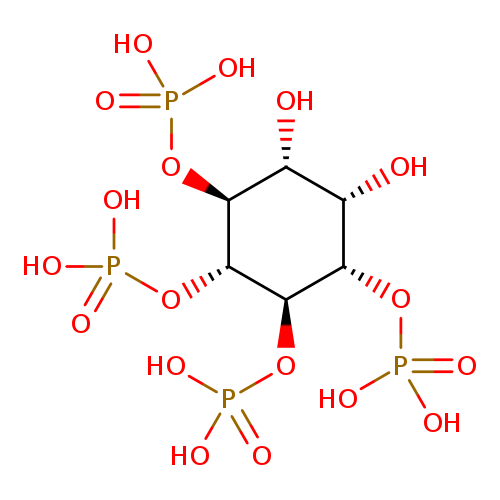
Common NameD-Myo-inositol 3,4,5,6-tetrakisphosphate
DescriptionD-Myo-d-myo-inositol 3,4,5,6-tetrakisphosphate, also known as ins-3,4,5,6-P4 or d-myo-inositol 3,4,5,6-tetrakisphosphate, belongs to the class of organic compounds known as inositol phosphates. Inositol phosphates are compounds containing a phosphate group attached to an inositol (or cyclohexanehexol) moiety. D-Myo-d-myo-inositol 3,4,5,6-tetrakisphosphate is possibly soluble (in water) and an extremely strong acidic compound (based on its pKa). D-Myo-d-myo-inositol 3,4,5,6-tetrakisphosphate participates in a number of enzymatic reactions, within cattle. In particular, D-Myo-d-myo-inositol 3,4,5,6-tetrakisphosphate can be biosynthesized from inositol 1,3,4,5,6-pentakisphosphate; which is mediated by the enzyme inositol-tetrakisphosphate 1-kinase. In addition, D-Myo-d-myo-inositol 3,4,5,6-tetrakisphosphate can be biosynthesized from inositol 1,3,4,5,6-pentakisphosphate through the action of the enzyme inositol-tetrakisphosphate 1-kinase. In cattle, D-myo-d-myo-inositol 3,4,5,6-tetrakisphosphate is involved in a couple of metabolic pathways, which include the inositol metabolism pathway and the inositol phosphate metabolism pathway.
Structure
Thumb
Synonyms
ValueSource
Inositol-3,4,5,6-tetraphosphateChEBI
Ins-3,4,5,6-P4ChEBI
Myo-inositol-3,4,5,6-tetrakisphosphateChEBI
Inositol 3,4,5,6-tetrakisphosphateKegg
Inositol-3,4,5,6-tetraphosphoric acidGenerator
Myo-inositol-3,4,5,6-tetrakisphosphoric acidGenerator
Inositol 3,4,5,6-tetrakisphosphoric acidGenerator
D-Myo-inositol 3,4,5,6-tetrakisphosphoric acidGenerator
1D-myo-Inositol 3,4,5,6-tetrakisphosphateHMDB
D-myo-Inositol, 3,4,5,6-tetrakis(dihydrogen phosphate)HMDB
Ins(3,4,5,6)P3MeSH, HMDB
D-myo-Inositol 3,4,5,6-tetrakisphosphateHMDB
D-myo-Inositol 3,4,5,6-tetraphosphateHMDB
Inositol 3,4,5,6-tetrakis(phosphate)HMDB
Inositol 3,4,5,6-tetraphosphateHMDB
Ins(3,4,5,6)P4HMDB
Chemical FormulaC6H16O18P4
Average Molecular Weight500.0755
Monoisotopic Molecular Weight499.928709756
IUPAC Name{[(1R,2S,3R,4S,5S,6R)-3,4-dihydroxy-2,5,6-tris(phosphonooxy)cyclohexyl]oxy}phosphonic acid
Traditional Name[(1R,2S,3R,4S,5S,6R)-3,4-dihydroxy-2,5,6-tris(phosphonooxy)cyclohexyl]oxyphosphonic acid
CAS Registry Number112791-61-4
SMILES
O[C@H]1[C@@H](O)[C@H](OP(O)(O)=O)[C@@H](OP(O)(O)=O)[C@H](OP(O)(O)=O)[C@H]1OP(O)(O)=O
InChI Identifier
InChI=1S/C6H16O18P4/c7-1-2(8)4(22-26(12,13)14)6(24-28(18,19)20)5(23-27(15,16)17)3(1)21-25(9,10)11/h1-8H,(H2,9,10,11)(H2,12,13,14)(H2,15,16,17)(H2,18,19,20)/t1-,2+,3-,4-,5+,6+/m0/s1
InChI KeyMRVYFOANPDTYBY-UZAAGFTCSA-N
Chemical Taxonomy
Description belongs to the class of organic compounds known as inositol phosphates. Inositol phosphates are compounds containing a phosphate group attached to an inositol (or cyclohexanehexol) moiety.
KingdomOrganic compounds
Super ClassOrganic oxygen compounds
ClassOrganooxygen compounds
Sub ClassAlcohols and polyols
Direct ParentInositol phosphates
Alternative Parents
Substituents
  • Inositol phosphate
  • Monoalkyl phosphate
  • Cyclohexanol
  • Alkyl phosphate
  • Phosphoric acid ester
  • Organic phosphoric acid derivative
  • Secondary alcohol
  • 1,2-diol
  • Organic oxide
  • Hydrocarbon derivative
  • Aliphatic homomonocyclic compound
Molecular FrameworkAliphatic homomonocyclic compounds
External Descriptors
Ontology
StatusExpected but not Quantified
Origin
  • Endogenous
BiofunctionNot Available
ApplicationNot Available
Cellular locationsNot Available
Physical Properties
StateSolid
Experimental Properties
PropertyValueReference
Melting PointNot AvailableNot Available
Boiling PointNot AvailableNot Available
Water SolubilityNot AvailableNot Available
LogP-7.268Not Available
Predicted Properties
PropertyValueSource
logP-0.45ALOGPS
logP-4.3ChemAxon
logS-1.6ALOGPS
pKa (Strongest Acidic)0.24ChemAxon
Physiological Charge-8ChemAxon
Hydrogen Acceptor Count14ChemAxon
Hydrogen Donor Count10ChemAxon
Polar Surface Area307.5 ŲChemAxon
Rotatable Bond Count8ChemAxon
Refractivity79.27 m³·mol⁻¹ChemAxon
Polarizability33.99 ųChemAxon
Number of Rings1ChemAxon
BioavailabilityYesChemAxon
Rule of FiveYesChemAxon
Ghose FilterYesChemAxon
Veber's RuleYesChemAxon
MDDR-like RuleYesChemAxon
Spectra
Spectra
Spectrum TypeDescriptionSplash Key
Predicted GC-MSPredicted GC-MS Spectrum - GC-MS (Non-derivatized) - 70eV, Positivesplash10-0002-9122600000-383a9e0d030e04f9efbcView in MoNA
Predicted GC-MSPredicted GC-MS Spectrum - GC-MS (2 TMS) - 70eV, Positivesplash10-0fdk-9721484000-b7d5efdc25d786b39d17View in MoNA
Predicted GC-MSPredicted GC-MS Spectrum - GC-MS (Non-derivatized) - 70eV, PositiveNot AvailableView in JSpectraViewer
Predicted LC-MS/MSPredicted LC-MS/MS Spectrum - 10V, Positivesplash10-0udi-5000790000-5390e100a7edacead23dView in MoNA
Predicted LC-MS/MSPredicted LC-MS/MS Spectrum - 20V, Positivesplash10-0ue9-3000940000-553717cc294ea575f253View in MoNA
Predicted LC-MS/MSPredicted LC-MS/MS Spectrum - 40V, Positivesplash10-0pba-3109000000-2fceafe8a79fc5fd8156View in MoNA
Predicted LC-MS/MSPredicted LC-MS/MS Spectrum - 10V, Negativesplash10-0002-3000900000-724d0d2ad6f25c90d193View in MoNA
Predicted LC-MS/MSPredicted LC-MS/MS Spectrum - 20V, Negativesplash10-004i-9002100000-815d445436dd2d0ccdbcView in MoNA
Predicted LC-MS/MSPredicted LC-MS/MS Spectrum - 40V, Negativesplash10-004i-9000000000-2dc66a8603e5713437a3View in MoNA
Predicted LC-MS/MSPredicted LC-MS/MS Spectrum - 10V, Positivesplash10-0udi-0000090000-2a395f5fa8fd29e0fb49View in MoNA
Predicted LC-MS/MSPredicted LC-MS/MS Spectrum - 20V, Positivesplash10-0udi-0000290000-2a13e4f6bebe4598fbd9View in MoNA
Predicted LC-MS/MSPredicted LC-MS/MS Spectrum - 40V, Positivesplash10-0uk9-4309200000-6cea3cc017b0547b118bView in MoNA
Predicted LC-MS/MSPredicted LC-MS/MS Spectrum - 10V, Negativesplash10-0002-0000900000-43744c672ffce8e5f032View in MoNA
Predicted LC-MS/MSPredicted LC-MS/MS Spectrum - 20V, Negativesplash10-000t-2000900000-1b7f098afeb3b6106811View in MoNA
Predicted LC-MS/MSPredicted LC-MS/MS Spectrum - 40V, Negativesplash10-004i-9000100000-7111fc5de7c9d1b376ffView in MoNA
1D NMR1H NMR Spectrum (1D, 100 MHz, D2O, predicted)Not AvailableView in JSpectraViewer
1D NMR13C NMR Spectrum (1D, 100 MHz, D2O, predicted)Not AvailableView in JSpectraViewer
1D NMR1H NMR Spectrum (1D, 1000 MHz, D2O, predicted)Not AvailableView in JSpectraViewer
1D NMR13C NMR Spectrum (1D, 1000 MHz, D2O, predicted)Not AvailableView in JSpectraViewer
1D NMR1H NMR Spectrum (1D, 200 MHz, D2O, predicted)Not AvailableView in JSpectraViewer
1D NMR13C NMR Spectrum (1D, 200 MHz, D2O, predicted)Not AvailableView in JSpectraViewer
1D NMR1H NMR Spectrum (1D, 300 MHz, D2O, predicted)Not AvailableView in JSpectraViewer
1D NMR13C NMR Spectrum (1D, 300 MHz, D2O, predicted)Not AvailableView in JSpectraViewer
1D NMR1H NMR Spectrum (1D, 400 MHz, D2O, predicted)Not AvailableView in JSpectraViewer
1D NMR13C NMR Spectrum (1D, 400 MHz, D2O, predicted)Not AvailableView in JSpectraViewer
1D NMR1H NMR Spectrum (1D, 500 MHz, D2O, predicted)Not AvailableView in JSpectraViewer
1D NMR13C NMR Spectrum (1D, 500 MHz, D2O, predicted)Not AvailableView in JSpectraViewer
1D NMR1H NMR Spectrum (1D, 600 MHz, D2O, predicted)Not AvailableView in JSpectraViewer
1D NMR13C NMR Spectrum (1D, 600 MHz, D2O, predicted)Not AvailableView in JSpectraViewer
1D NMR1H NMR Spectrum (1D, 700 MHz, D2O, predicted)Not AvailableView in JSpectraViewer
1D NMR13C NMR Spectrum (1D, 700 MHz, D2O, predicted)Not AvailableView in JSpectraViewer
1D NMR1H NMR Spectrum (1D, 800 MHz, D2O, predicted)Not AvailableView in JSpectraViewer
1D NMR13C NMR Spectrum (1D, 800 MHz, D2O, predicted)Not AvailableView in JSpectraViewer
1D NMR1H NMR Spectrum (1D, 900 MHz, D2O, predicted)Not AvailableView in JSpectraViewer
1D NMR13C NMR Spectrum (1D, 900 MHz, D2O, predicted)Not AvailableView in JSpectraViewer
Biological Properties
Cellular LocationsNot Available
Biospecimen LocationsNot Available
Pathways
Normal Concentrations
Not Available
Abnormal Concentrations
Not Available
HMDB IDHMDB0003848
DrugBank IDNot Available
Phenol Explorer Compound IDNot Available
FooDB IDFDB023236
KNApSAcK IDNot Available
Chemspider ID108765
KEGG Compound IDC04520
BioCyc IDCPD-178
BiGG ID43973
Wikipedia LinkNot Available
METLIN IDNot Available
PubChem Compound121920
PDB IDNot Available
ChEBI ID15844
References
Synthesis ReferenceMorgan Adam J; Komiya Shio; Xu Yingju; Miller Scott J Unified total syntheses of the inositol polyphosphates: D-I-3,5,6P3, D-I-3,4,5P3, D-I-3,4,6P3, and D-I-3,4,5,6P4 via catalytic enantioselective and site-selective phosphorylation. The Journal of organic chemistry (2006), 71(18), 6923-31.
Material Safety Data Sheet (MSDS)Not Available
General ReferencesNot Available

Enzymes

General function:
Involved in ATP binding
Specific function:
Kinase that can phosphorylate various inositol polyphosphate such as Ins(3,4,5,6)P4 or Ins(1,3,4)P3. Phosphorylates Ins(3,4,5,6)P4 at position 1 to form Ins(1,3,4,5,6)P5. This reaction is thought to have regulatory importance, since Ins(3,4,5,6)P4 is an inhibitor of plasma membrane Ca(2+)-activated Cl(-) channels, while Ins(1,3,4,5,6)P5 is not. Also acts as an inositol polyphosphate phosphatase that dephosphorylate Ins(1,3,4,5)P4 and Ins(1,3,4,6)P4 to Ins(1,3,4)P3, and Ins(1,3,4,5,6)P5 to Ins(3,4,5,6)P4. May also act as an isomerase that interconverts the inositol tetrakisphosphate isomers Ins(1,3,4,5)P4 and Ins(1,3,4,6)P4 in the presence of ADP and magnesium. Probably acts as the rate-limiting enzyme of the InsP6 pathway. Modifies TNF-alpha-induced apoptosis by interfering with the activation of TNFRSF1A-associated death domain (By similarity). Also phosphorylates Ins(1,3,4)P3 on O-5 and O-6 to form Ins(1,3,4,6)P4, an essential molecule in the hexakisphosphate (InsP6) pathway. Plays an important role in MLKL-mediated necroptosis. Produces highly phosphorylated inositol phosphates such as inositolhexakisphosphate (InsP6) which bind to MLKL mediating the release of an N-terminal auto-inhibitory region leading to its activation. Essential for activated phospho-MLKL to oligomerize and localize to the cell membrane during necroptosis (By similarity).
Gene Name:
ITPK1
Uniprot ID:
P0C0T1
Molecular weight:
45842.0
Reactions
Inositol 1,3,4,5,6-pentakisphosphate + ADP → D-Myo-inositol 3,4,5,6-tetrakisphosphate + Adenosine triphosphatedetails