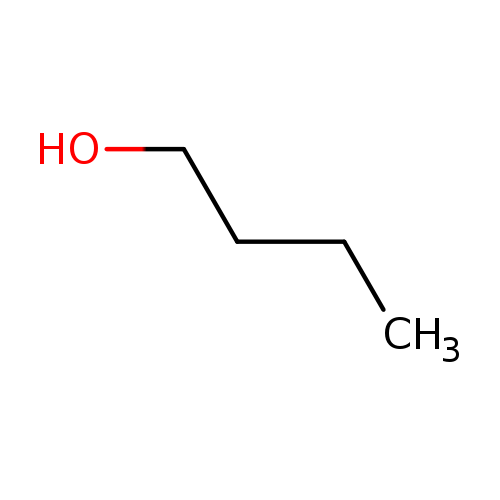
Record Information Version 1.0 Creation Date 2016-09-30 23:09:14 UTC Update Date 2026-11-27 16:58:27 UTC BMDB ID BMDB0004327 Secondary Accession Numbers Metabolite Identification Common Name 1-Butanol Description 1-Butanol, also known as 1-butyl alcohol or N-butan-1-ol, belongs to the class of organic compounds known as primary alcohols. Primary alcohols are compounds comprising the primary alcohol functional group, with the general structure RCOH (R=alkyl, aryl). Thus, 1-butanol is considered to be a fatty alcohol lipid molecule. 1-Butanol exists as a solid, very hydrophobic, practically insoluble (in water), and relatively neutral molecule. 1-Butanol exists in all living species, ranging from bacteria to humans. 1-Butanol has been found to be associated with several diseases known as diabetes mellitus type 2, nonalcoholic fatty liver disease, irritable bowel syndrome, and ulcerative colitis; also 1-butanol has been linked to the inborn metabolic disorders including celiac disease.
Structure Synonyms Value Source 1-Butyl alcohol ChEBI 1-Hydroxybutane ChEBI BuOH ChEBI N-Butan-1-ol ChEBI N-Butanol ChEBI N-Butyl alcohol ChEBI N-Butylalkohol ChEBI Propyl carbinol ChEBI Butan-1-ol Kegg Butanol HMDB Butyl alcohol HMDB Butyl hydroxide HMDB Hemostyp HMDB Methylolpropane HMDB Propylcarbinol HMDB Alcohol, N-butyl HMDB N Butyl alcohol HMDB Alcohol, butyl HMDB 1 Butanol HMDB N Butanol HMDB 1-Butanol ChEBI
Chemical Formula C4 H10 O Average Molecular Weight 74.1216 Monoisotopic Molecular Weight 74.073164942 IUPAC Name butan-1-ol Traditional Name butanol CAS Registry Number 71-36-3 SMILES CCCCO
InChI Identifier InChI=1S/C4H10O/c1-2-3-4-5/h5H,2-4H2,1H3
InChI Key LRHPLDYGYMQRHN-UHFFFAOYSA-N Chemical Taxonomy Description belongs to the class of organic compounds known as primary alcohols. Primary alcohols are compounds comprising the primary alcohol functional group, with the general structure RCOH (R=alkyl, aryl). Kingdom Organic compounds Super Class Organic oxygen compounds Class Organooxygen compounds Sub Class Alcohols and polyols Direct Parent Primary alcohols Alternative Parents Substituents Hydrocarbon derivative
Primary alcohol
Aliphatic acyclic compound Molecular Framework Aliphatic acyclic compounds External Descriptors Ontology Status Detected and Quantified Origin Biofunction Not Available
Application Not Available
Cellular locations Not Available
Physical Properties State Liquid Experimental Properties Property Value Reference Melting Point -89.8 °C Not Available Boiling Point Not Available Not Available Water Solubility 63.2 mg/mL at 25 °C Not Available LogP 0.88 HANSCH,C ET AL. (1995)
Predicted Properties Spectra Spectra
Biological Properties Cellular Locations Not Available
Biospecimen Locations Colostrum
Epidermis
Fibroblasts
Kidney
Liver
Milk
Muscle
Pancreas
Spleen Body Locations
Udder: Colostrum, Milk
Skin: Epidermis, Fibroblasts
Muscle: Muscle, Skeletal Muscle
Liver: Liver
Spleen: Spleen
Kidneys: Kidney
Intestines: Pancreas
Skin
Epidermis
Outermost layer of the skin, which forms a protective barrier.
Concentration references
Fibroblasts
Cells that make collagen and other connective-tissue fibres; important in wound healing.
Concentration references
Udder
Colostrum
First milk produced after calving. Rich in antibodies, protein and energy that protect the newborn calf.
Concentration references
Milk
Fluid secreted by the mammary gland to feed the calf; contains fat, protein, lactose, minerals and vitamins.
Concentration references
Intestines
Pancreas
Gland that releases digestive enzymes into the intestine and hormones such as insulin into the blood.
Concentration references
Kidneys
Kidney
Pair of organs that filter the blood, remove waste as urine and balance water and salts.
Concentration references
Liver
Liver
Large organ that processes nutrients, makes glucose and proteins, breaks down toxins and makes bile. Central to energy metabolism in dairy cows.
Concentration references
Muscle
Muscle
Tissue that contracts to produce movement; in cattle, skeletal muscle is the meat.
Concentration references
Skeletal Muscle
Muscle attached to bones that moves the body under voluntary control; the meat in beef.
Curated tissue location; no reference linked.
Spleen
Spleen
Organ that filters the blood, removes old red blood cells and helps fight infection.
Concentration references
Environmental Sources Definition Detected in barn ENVO:03501257 An agricultural building used for crop storage or animal husbandry. details1 paper
A season long barn study in Japan also found ketones, alcohols, and volatile fatty acids accounting for >80 of TVOC mass, with acetone, 3 pentanone, 1 butanol, and acetic acid as the top contributors (Tanaka et al., 2019). Written in the paper as “1 butanol” and “barn”
Pathways Concentrations Epidermis Expected but not Quantified Not Quantified Not Specified Not Specified Normal detailsFibroblasts Expected but not Quantified Not Quantified Not Specified Not Specified Normal detailsKidney Expected but not Quantified Not Quantified Not Specified Not Specified Normal detailsLiver Expected but not Quantified Not Quantified Not Specified Not Specified Normal detailsMilk Detected and Quantified 0.00139 +/- 0.00208 uM Not Specified Not Specified Normal detailsMilk Detected and Quantified 0.000278 +/- 0.000695 uM Not Specified Not Specified Normal detailsMilk Detected and Quantified 0.00236 +/- 0.00292 uM Not Specified Not Specified Normal detailsPancreas Expected but not Quantified Not Quantified Not Specified Not Specified Normal detailsSpleen Expected but not Quantified Not Quantified Not Specified Not Specified Normal details
Change Colostrum Detected but not Quantified Not Quantified Not Specified Not Specified Commercial Product/bacterial growth on ground beef None found Not determined detailsMuscle Detected but not Quantified Not Quantified Not Specified Not Specified Commercial Product/bacterial growth on ground beef None found Not determined details
External Links HMDB ID HMDB0004327 DrugBank ID DB02145 Phenol Explorer Compound ID Not Available FooDB ID FDB031032 KNApSAcK ID C00035814 Chemspider ID 258 KEGG Compound ID C06142 BioCyc ID BUTANOL BiGG ID Not Available Wikipedia Link N-Butanol METLIN ID 7052 PubChem Compound 263 PDB ID 1BO ChEBI ID 28885 References Synthesis Reference Tsuchida, Takashi; Sakuma, Shuji. Ethanol to 1-butanol on hydroxyapatite. Shokubai (2007), 49(3), 238-243. Material Safety Data Sheet (MSDS) Not Available General References Toso B, Procida G, Stefanon B: Determination of volatile compounds in cows' milk using headspace GC-MS. J Dairy Res. 2002 Nov;69(4):569-77. [PubMed:12463694 ]