Record Information
Version1.0
Creation Date2016-09-30 23:33:52 UTC
Update Date2020-05-21 16:27:54 UTC
BMDB IDBMDB0007264
Secondary Accession Numbers
  • BMDB07264
Metabolite Identification
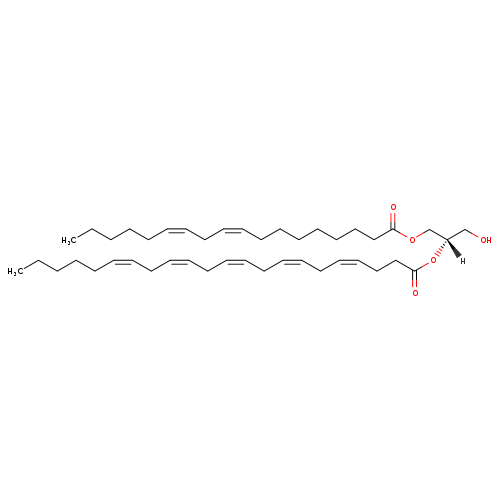
Common NameDG(18:2(9Z,12Z)/22:5(4Z,7Z,10Z,13Z,16Z)/0:0)
DescriptionDG(18:2(9Z,12Z)/22:5(4Z,7Z,10Z,13Z,16Z)/0:0), also known as dg(18:2(9z,12z)/22:5(4z,7z,10z,13z,16z)/0:0) or DG(18:2/22:5), belongs to the class of organic compounds known as 1,2-dg(18:2(9z,12z)/22:5(4z,7z,10z,13z,16z)/0:0)s. These are dg(18:2(9z,12z)/22:5(4z,7z,10z,13z,16z)/0:0)s containing a glycerol acylated at positions 1 and 2. DG(18:2(9Z,12Z)/22:5(4Z,7Z,10Z,13Z,16Z)/0:0) is possibly soluble (in water) and an extremely weak basic (essentially neutral) compound (based on its pKa). DG(18:2(9Z,12Z)/22:5(4Z,7Z,10Z,13Z,16Z)/0:0) participates in a number of enzymatic reactions, within cattle. In particular, DG(18:2(9Z,12Z)/22:5(4Z,7Z,10Z,13Z,16Z)/0:0) can be biosynthesized from PA(18:2(9Z,12Z)/22:5(4Z,7Z,10Z,13Z,16Z)) through the action of the enzyme phosphatidate phosphatase. In addition, DG(18:2(9Z,12Z)/22:5(4Z,7Z,10Z,13Z,16Z)/0:0) and tetracosanoyl-CoA can be converted into TG(18:2(9Z,12Z)/22:5(4Z,7Z,10Z,13Z,16Z)/24:0); which is mediated by the enzyme dg(18:2(9z,12z)/22:5(4z,7z,10z,13z,16z)/0:0) O-acyltransferase. In cattle, DG(18:2(9Z,12Z)/22:5(4Z,7Z,10Z,13Z,16Z)/0:0) is involved in the metabolic pathway called de novo triacylglycerol biosynthesis TG(18:2(9Z,12Z)/22:5(4Z,7Z,10Z,13Z,16Z)/24:0) pathway.
Structure
Thumb
Synonyms
ValueSource
Diacylglycerol(18:2/22:5)HMDB
DAG(40:7)HMDB
DiglycerideHMDB
DG(40:7)HMDB
DG(18:2/22:5)HMDB
DiacylglycerolHMDB
1-Linoleoyl-2-osbondoyl-sn-glycerolHMDB
DAG(18:2/22:5)HMDB
1-(9Z,12Z-Octadecadienoyl)-2-(4Z,7Z,10Z,13Z,16Z-docosapentaenoyl)-sn-glycerolHMDB
Diacylglycerol(40:7)HMDB
DG(18:2(9Z,12Z)/22:5(4Z,7Z,10Z,13Z,16Z)/0:0)Lipid Annotator
Chemical FormulaC43H70O5
Average Molecular Weight667.0129
Monoisotopic Molecular Weight666.52232535
IUPAC Name(2S)-1-hydroxy-3-[(9Z,12Z)-octadeca-9,12-dienoyloxy]propan-2-yl (4Z,7Z,10Z,13Z,16Z)-docosa-4,7,10,13,16-pentaenoate
Traditional Namediacylglycerol
CAS Registry NumberNot Available
SMILES
[H][C@](CO)(COC(=O)CCCCCCC\C=C/C\C=C/CCCCC)OC(=O)CC\C=C/C\C=C/C\C=C/C\C=C/C\C=C/CCCCC
InChI Identifier
InChI=1S/C43H70O5/c1-3-5-7-9-11-13-15-17-19-20-21-22-24-26-28-30-32-34-36-38-43(46)48-41(39-44)40-47-42(45)37-35-33-31-29-27-25-23-18-16-14-12-10-8-6-4-2/h11-14,17-19,21-23,26,28,32,34,41,44H,3-10,15-16,20,24-25,27,29-31,33,35-40H2,1-2H3/b13-11-,14-12-,19-17-,22-21-,23-18-,28-26-,34-32-/t41-/m0/s1
InChI KeyVQRULMYDUJBUJI-JQDWYLMKSA-N
Chemical Taxonomy
Description belongs to the class of organic compounds known as 1,2-diacylglycerols. These are diacylglycerols containing a glycerol acylated at positions 1 and 2.
KingdomOrganic compounds
Super ClassLipids and lipid-like molecules
ClassGlycerolipids
Sub ClassDiradylglycerols
Direct Parent1,2-diacylglycerols
Alternative Parents
Substituents
  • 1,2-acyl-sn-glycerol
  • Fatty acid ester
  • Fatty acyl
  • Dicarboxylic acid or derivatives
  • Carboxylic acid ester
  • Carboxylic acid derivative
  • Organic oxygen compound
  • Organic oxide
  • Hydrocarbon derivative
  • Primary alcohol
  • Organooxygen compound
  • Carbonyl group
  • Alcohol
  • Aliphatic acyclic compound
Molecular FrameworkAliphatic acyclic compounds
External DescriptorsNot Available
Ontology
StatusExpected but not Quantified
Origin
  • Endogenous
  • Exogenous
BiofunctionNot Available
ApplicationNot Available
Cellular locations
  • Cell membrane
  • Membrane
Physical Properties
StateSolid
Experimental Properties
PropertyValueReference
Melting PointNot AvailableNot Available
Boiling PointNot AvailableNot Available
Water SolubilityNot AvailableNot Available
LogPNot AvailableNot Available
Predicted Properties
PropertyValueSource
logP9.15ALOGPS
logP13.03ChemAxon
logS-7.7ALOGPS
pKa (Strongest Acidic)14.58ChemAxon
pKa (Strongest Basic)-3ChemAxon
Physiological Charge0ChemAxon
Hydrogen Acceptor Count3ChemAxon
Hydrogen Donor Count1ChemAxon
Polar Surface Area72.83 ŲChemAxon
Rotatable Bond Count35ChemAxon
Refractivity212.32 m³·mol⁻¹ChemAxon
Polarizability82.54 ųChemAxon
Number of Rings0ChemAxon
BioavailabilityYesChemAxon
Rule of FiveYesChemAxon
Ghose FilterYesChemAxon
Veber's RuleYesChemAxon
MDDR-like RuleYesChemAxon
Spectra
Spectra
Spectrum TypeDescriptionSplash Key
Predicted GC-MSPredicted GC-MS Spectrum - GC-MS (Non-derivatized) - 70eV, Positivesplash10-01p9-2297143000-645ef8d8e33d27e5088eView in MoNA
Predicted GC-MSPredicted GC-MS Spectrum - GC-MS (TMS_1_1) - 70eV, PositiveNot AvailableView in JSpectraViewer
Predicted GC-MSPredicted GC-MS Spectrum - GC-MS (TBDMS_1_1) - 70eV, PositiveNot AvailableView in JSpectraViewer
Predicted LC-MS/MSPredicted LC-MS/MS Spectrum - 10V, Positivesplash10-03y0-1049004000-0df9f99ae6ba81665a54View in MoNA
Predicted LC-MS/MSPredicted LC-MS/MS Spectrum - 20V, Positivesplash10-03dr-2098031000-ae8574434c1f989532d9View in MoNA
Predicted LC-MS/MSPredicted LC-MS/MS Spectrum - 40V, Positivesplash10-01w0-1092030000-2a795592ac56ce122956View in MoNA
Predicted LC-MS/MSPredicted LC-MS/MS Spectrum - 10V, Negativesplash10-01t9-0096003000-c124aa4c41332f12c6d6View in MoNA
Predicted LC-MS/MSPredicted LC-MS/MS Spectrum - 20V, Negativesplash10-01t9-1093000000-5eacd9e70cc7dd930349View in MoNA
Predicted LC-MS/MSPredicted LC-MS/MS Spectrum - 40V, Negativesplash10-01t9-4095000000-8d492ea972d8174d033dView in MoNA
Predicted LC-MS/MSPredicted LC-MS/MS Spectrum - 10V, Positivesplash10-000i-0000009000-280b86e4414b53facf72View in MoNA
Predicted LC-MS/MSPredicted LC-MS/MS Spectrum - 20V, Positivesplash10-000i-0000009000-280b86e4414b53facf72View in MoNA
Predicted LC-MS/MSPredicted LC-MS/MS Spectrum - 40V, Positivesplash10-0a4i-0009601000-5db69070b2ff4307df7eView in MoNA
Predicted LC-MS/MSPredicted LC-MS/MS Spectrum - 10V, Positivesplash10-02t9-1039046000-8b941bebaba482267cc1View in MoNA
Predicted LC-MS/MSPredicted LC-MS/MS Spectrum - 20V, Positivesplash10-03di-2129001000-09812711f94e410e7ce9View in MoNA
Predicted LC-MS/MSPredicted LC-MS/MS Spectrum - 40V, Positivesplash10-03e9-1259010000-3904b68b34a4385b7a1bView in MoNA
Predicted LC-MS/MSPredicted LC-MS/MS Spectrum - 10V, Negativesplash10-014i-1047009000-6c7377bd093bc5f4da47View in MoNA
Predicted LC-MS/MSPredicted LC-MS/MS Spectrum - 20V, Negativesplash10-004i-6097001000-680dbe31436ca1d3ef2fView in MoNA
Predicted LC-MS/MSPredicted LC-MS/MS Spectrum - 40V, Negativesplash10-01t9-5196000000-7fa8f8ebbed6b697e6a3View in MoNA
Predicted LC-MS/MSPredicted LC-MS/MS Spectrum - 10V, Positivesplash10-001i-0000009000-64b93739ea49f5c060aaView in MoNA
Predicted LC-MS/MSPredicted LC-MS/MS Spectrum - 20V, Positivesplash10-000i-0009004000-f82a9b6569134370a5a1View in MoNA
Predicted LC-MS/MSPredicted LC-MS/MS Spectrum - 40V, Positivesplash10-000i-0009004000-3a1e500e4e631eabba28View in MoNA
Biological Properties
Cellular Locations
  • Cell membrane
  • Membrane
Biospecimen Locations
  • All Tissues
Pathways
Normal Concentrations
BiospecimenStatusValueAgeSexConditionReferenceDetails
All TissuesExpected but not QuantifiedNot QuantifiedNot SpecifiedNot SpecifiedNormal
  • Not Applicable
details
Abnormal Concentrations
Not Available
HMDB IDHMDB0007264
DrugBank IDNot Available
Phenol Explorer Compound IDNot Available
FooDB IDFDB024457
KNApSAcK IDNot Available
Chemspider IDNot Available
KEGG Compound IDNot Available
BioCyc IDNot Available
BiGG IDNot Available
Wikipedia LinkNot Available
METLIN IDNot Available
PubChem Compound53478109
PDB IDNot Available
ChEBI ID89174
References
Synthesis ReferenceNot Available
Material Safety Data Sheet (MSDS)Not Available
General ReferencesNot Available

Enzymes

General function:
Involved in ethanolaminephosphotransferase activity
Specific function:
Catalyzes phosphatidylethanolamine biosynthesis from CDP-ethanolamine. It thereby plays a central role in the formation and maintenance of vesicular membranes. Involved in the foramtion of phosphatidylethanolamine via 'Kennedy' pathway (By similarity).
Gene Name:
SELENOI
Uniprot ID:
Q17QM4
Molecular weight:
45214.0
Reactions
CDP-Ethanolamine + DG(18:2(9Z,12Z)/22:5(4Z,7Z,10Z,13Z,16Z)/0:0) → Cytidine monophosphate + PE(18:2(9Z,12Z)/22:5(4Z,7Z,10Z,13Z,16Z))details
General function:
Not Available
Specific function:
Catalyzes the terminal and only committed step in triacylglycerol synthesis by using diacylglycerol and fatty acyl CoA as substrates. In contrast to DGAT2 it is not essential for survival. May be involved in VLDL (very low density lipoprotein) assembly. Functions as the major acyl-CoA retinol acyltransferase (ARAT) in the skin, where it acts to maintain retinoid homeostasis and prevent retinoid toxicity leading to skin and hair disorders. In liver, plays a role in esterifying exogenous fatty acids to glycerol.
Gene Name:
DGAT1
Uniprot ID:
Q8MK44
Molecular weight:
55602.0
Reactions
DG(18:2(9Z,12Z)/22:5(4Z,7Z,10Z,13Z,16Z)/0:0) + Clupanodonyl CoA → TG(18:2(9Z,12Z)/22:5(4Z,7Z,10Z,13Z,16Z)/22:5(7Z,10Z,13Z,16Z,19Z)) + Coenzyme Adetails