| Record Information |
|---|
| Version | 1.0 |
|---|
| Creation Date | 2016-10-03 18:12:02 UTC |
|---|
| Update Date | 2020-05-11 19:13:43 UTC |
|---|
| BMDB ID | BMDB0010696 |
|---|
| Secondary Accession Numbers | |
|---|
| Metabolite Identification |
|---|
| Common Name | CL(20:4(8Z,11Z,14Z,17Z)/20:3(8Z,11Z,14Z)/18:2(9Z,12Z)/16:1(9Z)) |
|---|
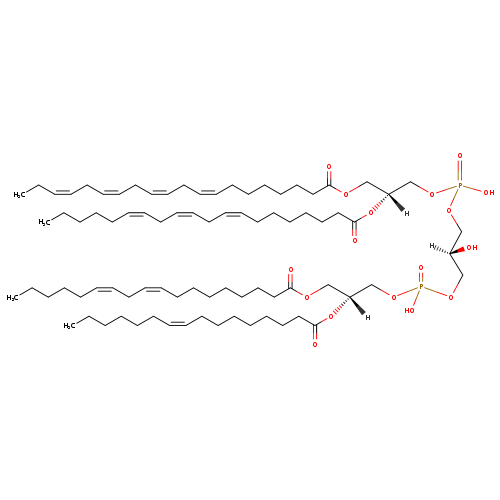
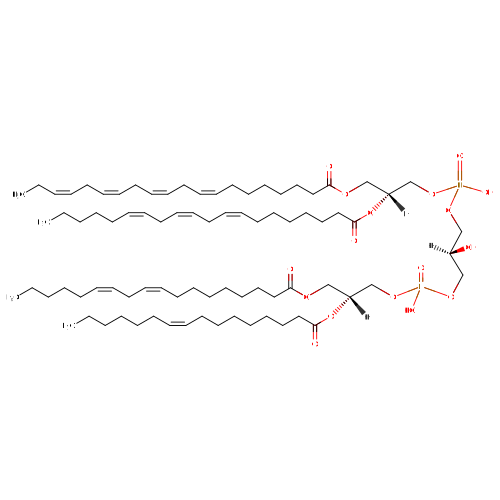
| Description | CL(20:4(8Z,11Z,14Z,17Z)/20:3(8Z,11Z,14Z)/18:2(9Z,12Z)/16:1(9Z)) is a cardiolipin (CL). Cardiolipins are sometimes called 'double' phospholipids because they have four fatty acid tails, instead of the usual two. They are glycerophospholipids in which the O1 and O3 oxygen atoms of the central glycerol moiety are each linked to one 1,3-diacylglyerol chain. Their general formula is OC(COP(O)(=O)OC[C@@H](CO[R1])O[R2])COP(O)(=O)OC[C@@H](CO[R3])O[R4], where R1-R4 are four fatty acyl chains. CL(20:4(8Z,11Z,14Z,17Z)/20:3(8Z,11Z,14Z)/18:2(9Z,12Z)/16:1(9Z)) contains one chain of (8Z,11Z,14Z,17Z-eicosapentaenoyl) at the C1 position, one chain of (8Z,11Z,14Z-eicosatrienoyl) at the C2 position, one chain of (9Z,12Z-octadecadienoyl) at the C3 position, one chain of (9Z-hexadecenoyl) at the C4 position fatty acids. Cardiolipins are known to be present in all mammalian cells, especially cells with a high number of mitochondria. De novo synthesis of Cardiolipins begins with condensing phosphatidic acid (PA) with cytidine-5’-triphosphate (CTP) to form cytidine-diphosphate-1,2-diacyl-sn-glycerol (CDP-DG). Glycerol-3-phosphate is subsequently added to this newly formed CDP-DG molecule to form phosphatidylglycerol phosphate (PGP), which is immediately dephosphorylated to form PG. The final step is the process of condensing the PG molecule with another CDP-DG molecule to form a new cardiolipin, which is catalyzed by cardiolipin synthase. All new cardiolipins immediately undergo a series remodeling resulting in the common cardiolipin compositions. (PMID: 16442164 ). Cardiolipin synthase shows no selectivity for fatty acyl chains used in the de novo synthesis of cardiolipin (PMID: 16442164 ). Cardiolipins (bisphosphatidyl glycerol) are an important component of the inner mitochondrial membrane, where they constitute about 20% of the total lipid. While most lipids are made in the endoplasmic reticulum, cardiolipin is synthesized on the matrix side of the inner mitochondrial membrane and are important for mitochondrial respiratory capacity. They are highly abundant in metabolically active cells (heart, muscle) and play an important role in the blood clotting process. Tafazzin is an important enzyme in the remodeling of cardiolipins, and in contrast to cardiolipin synthase, it shows strong acyl specificity. This suggests that the specificity in cardiolipin composition is achieved through the remodeling steps. Mutation in the tafazzin gene disrupts the remodeling of cardiolipins and is the cause of Barth syndrome (BTHS), an X-linked human disease (PMID: 16973164 ). BTHS patients seem to lack acyl specificity. As a result, there are many potential cardiolipin species that can exist (PMID: 16226238 ). |
|---|
| Structure | |
|---|
| Synonyms | | Value | Source |
|---|
| 1'-[1-Eicsoate | HMDB | | 1'-[1-Eicsoatetraenoyl-2-homo-g-linolenoyl-sn-glycero-3-phospho],3'-[1,2-dilinoleoyl-rac-glycero-3-phospho]-glycerol | HMDB | | 1'-[1-Eicsoatetraenoyl-2-homo-gamma-linolenoyl-sn-glycero-3-phospho],3'-[1,2-dilinoleoyl-rac-glycero-3-phospho]-glycerol | HMDB | | 1'-[1-Eicsoic acid | HMDB | | Cardiolipin(20:4/20:3/18:2/18:2) | HMDB | | Cardiolipin(20:4N3/20:3N6/18:2N6/18:2N6) | HMDB | | Cardiolipin(20:4W3/20:3W6/18:2W6/18:2W6) | HMDB | | Cardiolipin(76:11) | HMDB | | Cardiolipins(20:4/20:3/18:2/18:2) | HMDB | | Cardiolipins(20:4N3/20:3N6/18:2N6/18:2N6) | HMDB | | Cardiolipins(20:4W3/20:3W6/18:2W6/18:2W6) | HMDB | | Cardiolipins(76:11) | HMDB | | CL(1'-[20:4(8Z,11Z,14Z,17Z)/20:3(8Z,11Z,14Z)],3'-[18:2(9Z,12Z)/18:2(9Z,12Z)]) | HMDB | | CL(20:4/20:3/18:2/18:2) | HMDB | | CL(20:4N3/20:3N6/18:2N6/18:2N6) | HMDB | | CL(20:4W3/20:3W6/18:2W6/18:2W6) | HMDB | | CL(76:11) | HMDB | | 1'-[1-(8Z,11Z,14Z,17Z-Eicosapentaenoyl)-2-(8Z,11Z,14Z-eicosatrienoyl)-sn-glycero-3-phospho],3'-[1,2-di(9Z,12Z-octadecadienoyl)-rac-glycero-3-phospho]-glycerol | HMDB | | CL(20:4(8Z,11Z,14Z,17Z)/20:3(8Z,11Z,14Z)/18:2(9Z,12Z)/16:1(9Z)) | Lipid Annotator |
|
|---|
| Chemical Formula | C83H142O17P2 |
|---|
| Average Molecular Weight | 1473.9529 |
|---|
| Monoisotopic Molecular Weight | 1472.972226142 |
|---|
| IUPAC Name | [3-({[(2R)-2-[(9Z)-hexadec-9-enoyloxy]-3-[(9Z,12Z)-octadeca-9,12-dienoyloxy]propoxy](hydroxy)phosphoryl}oxy)-2-hydroxypropoxy][(2R)-3-[(8Z,11Z,14Z,17Z)-icosa-8,11,14,17-tetraenoyloxy]-2-[(8Z,11Z,14Z)-icosa-8,11,14-trienoyloxy]propoxy]phosphinic acid |
|---|
| Traditional Name | 3-{[(2R)-2-[(9Z)-hexadec-9-enoyloxy]-3-[(9Z,12Z)-octadeca-9,12-dienoyloxy]propoxy(hydroxy)phosphoryl]oxy}-2-hydroxypropoxy(2R)-3-[(8Z,11Z,14Z,17Z)-icosa-8,11,14,17-tetraenoyloxy]-2-[(8Z,11Z,14Z)-icosa-8,11,14-trienoyloxy]propoxyphosphinic acid |
|---|
| CAS Registry Number | Not Available |
|---|
| SMILES | [H]C(O)(COP(O)(=O)OC[C@@]([H])(COC(=O)CCCCCCC\C=C/C\C=C/CCCCC)OC(=O)CCCCCCC\C=C/CCCCCC)COP(O)(=O)OC[C@@]([H])(COC(=O)CCCCCC\C=C/C\C=C/C\C=C/C\C=C/CC)OC(=O)CCCCCC\C=C/C\C=C/C\C=C/CCCCC |
|---|
| InChI Identifier | InChI=1S/C83H142O17P2/c1-5-9-13-17-21-25-29-33-36-38-41-45-48-52-56-60-64-68-81(86)94-74-79(100-83(88)70-66-62-58-54-50-46-42-39-37-34-30-26-22-18-14-10-6-2)76-98-102(91,92)96-72-77(84)71-95-101(89,90)97-75-78(99-82(87)69-65-61-57-53-49-43-32-28-24-20-16-12-8-4)73-93-80(85)67-63-59-55-51-47-44-40-35-31-27-23-19-15-11-7-3/h9,13,21-23,25-28,32-37,40-42,45-46,77-79,84H,5-8,10-12,14-20,24,29-31,38-39,43-44,47-76H2,1-4H3,(H,89,90)(H,91,92)/b13-9-,25-21-,26-22-,27-23-,32-28-,36-33-,37-34-,40-35-,45-41-,46-42-/t77-,78-,79-/m1/s1 |
|---|
| InChI Key | QUYNDBUZHKTFHR-SCLXOPDZSA-N |
|---|
| Chemical Taxonomy |
|---|
| Description | belongs to the class of organic compounds known as cardiolipins. These are glycerophospholipids in which the O1 and O3 oxygen atoms of the central glycerol moiety are each linked to one 1,2-diacylglycerol chain. Their general formula is OC(COP(O)(=O)OC[C@@H](CO[R1])O[R2])COP(O)(=O)OC[C@@H](CO[R3])O[R4], where R1-R4 are four fatty acyl chains. |
|---|
| Kingdom | Organic compounds |
|---|
| Super Class | Lipids and lipid-like molecules |
|---|
| Class | Glycerophospholipids |
|---|
| Sub Class | Glycerophosphoglycerophosphoglycerols |
|---|
| Direct Parent | Cardiolipins |
|---|
| Alternative Parents | Not Available |
|---|
| Substituents | Not Available |
|---|
| Molecular Framework | Not Available |
|---|
| External Descriptors | Not Available |
|---|
| Ontology |
|---|
| Status | Expected but not Quantified |
|---|
| Origin | |
|---|
| Biofunction | Not Available |
|---|
| Application | Not Available |
|---|
| Cellular locations | - Cell membrane
- Cytoplasm
- Endoplasmic reticulum
- Inner mitochondrial membrane
- Intracellular membrane
- Membrane
- Mitochondria
|
|---|
| Physical Properties |
|---|
| State | Solid |
|---|
| Experimental Properties | | Property | Value | Reference |
|---|
| Melting Point | Not Available | Not Available | | Boiling Point | Not Available | Not Available | | Water Solubility | Not Available | Not Available | | LogP | Not Available | Not Available |
|
|---|
| Predicted Properties | |
|---|
| Spectra |
|---|
| Spectra | |
|---|