Record Information
Version1.0
Creation Date2016-10-03 18:31:50 UTC
Update Date2020-04-22 15:48:20 UTC
BMDB IDBMDB0012076
Secondary Accession Numbers
  • BMDB12076
Metabolite Identification
Common NameGanglioside GT3 (d18:1/23:0)
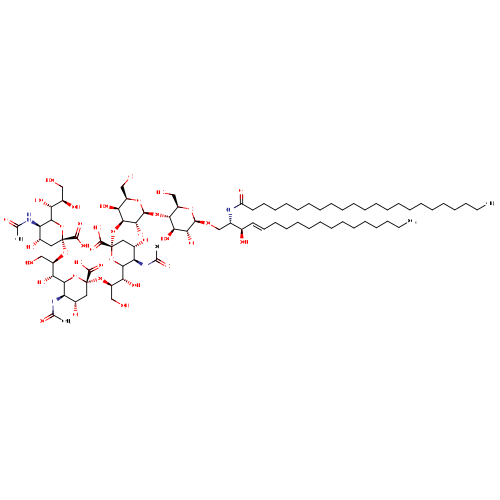
DescriptionGanglioside GT3 (d18:1/23:0) belongs to the class of organic compounds known as gangliosides. These are lipid molecules composed of a glycosphingolipid (ceramide and saccharide) with one or more sialic acids linked on the sugar chain. They are usually oligoglycosylceramides derived from lactosylceramide and containing a sialic acid residue such as N-acetylneuraminic acid. Ganglioside GT3 (d18:1/23:0) is an extremely weak basic (essentially neutral) compound (based on its pKa).
Structure
Thumb
Synonyms
ValueSource
(2S,4S,5R)-2-{[(1S,2R)-1-[(3R,4S,6S)-6-carboxy-6-{[(1S,2R)-1-[(3R,4S,6S)-6-carboxy-6-{[(2S,3R,4S,5S,6R)-2-{[(2R,3S,4R,5R,6R)-4,5-dihydroxy-6-{[(2S,3R,4E)-3-hydroxy-2-[(1-hydroxytricosylidene)amino]octadec-4-en-1-yl]oxy}-2-(hydroxymethyl)oxan-3-yl]oxy}-3,5-dihydroxy-6-(hydroxymethyl)oxan-4-yl]oxy}-4-hydroxy-3-[(1-hydroxyethylidene)amino]oxan-2-yl]-1,3-dihydroxypropan-2-yl]oxy}-4-hydroxy-3-[(1-hydroxyethylidene)amino]oxan-2-yl]-1,3-dihydroxypropan-2-yl]oxy}-4-hydroxy-5-[(1-hydroxyethylidene)amino]-6-[(1R,2R)-1,2,3-trihydroxypropyl]oxane-2-carboxylateHMDB
Chemical FormulaC86H152N4O37
Average Molecular Weight1834.1317
Monoisotopic Molecular Weight1833.013541898
IUPAC Name(2S,4S,5R)-6-[(1S,2R)-2-{[(2S,4S,5R)-2-carboxy-6-[(1S,2R)-2-{[(2S,4S,5R)-2-carboxy-5-acetamido-4-hydroxy-6-[(1R,2R)-1,2,3-trihydroxypropyl]oxan-2-yl]oxy}-1,3-dihydroxypropyl]-5-acetamido-4-hydroxyoxan-2-yl]oxy}-1,3-dihydroxypropyl]-2-{[(2S,3R,4S,5S,6R)-2-{[(2R,3S,4R,5R,6R)-4,5-dihydroxy-6-{[(2S,3R,4E)-3-hydroxy-2-tricosanamidooctadec-4-en-1-yl]oxy}-2-(hydroxymethyl)oxan-3-yl]oxy}-3,5-dihydroxy-6-(hydroxymethyl)oxan-4-yl]oxy}-5-acetamido-4-hydroxyoxane-2-carboxylic acid
Traditional Name(2S,4S,5R)-6-[(1S,2R)-2-{[(2S,4S,5R)-2-carboxy-6-[(1S,2R)-2-{[(2S,4S,5R)-2-carboxy-5-acetamido-4-hydroxy-6-[(1R,2R)-1,2,3-trihydroxypropyl]oxan-2-yl]oxy}-1,3-dihydroxypropyl]-5-acetamido-4-hydroxyoxan-2-yl]oxy}-1,3-dihydroxypropyl]-2-{[(2S,3R,4S,5S,6R)-2-{[(2R,3S,4R,5R,6R)-4,5-dihydroxy-6-{[(2S,3R,4E)-3-hydroxy-2-tricosanamidooctadec-4-en-1-yl]oxy}-2-(hydroxymethyl)oxan-3-yl]oxy}-3,5-dihydroxy-6-(hydroxymethyl)oxan-4-yl]oxy}-5-acetamido-4-hydroxyoxane-2-carboxylic acid
CAS Registry NumberNot Available
SMILES
CCCCCCCCCCCCCCCCCCCCCCC(=O)N[C@@H](CO[C@@H]1O[C@H](CO)[C@@H](O[C@@H]2O[C@H](CO)[C@H](O)[C@H](O[C@@]3(C[C@H](O)[C@@H](NC(C)=O)C(O3)[C@H](O)[C@@H](CO)O[C@@]3(C[C@H](O)[C@@H](NC(C)=O)C(O3)[C@H](O)[C@@H](CO)O[C@@]3(C[C@H](O)[C@@H](NC(C)=O)C(O3)[C@H](O)[C@H](O)CO)C(O)=O)C(O)=O)C(O)=O)[C@H]2O)[C@H](O)[C@H]1O)[C@H](O)\C=C\CCCCCCCCCCCCC
InChI Identifier
InChI=1S/C86H152N4O37/c1-6-8-10-12-14-16-18-20-21-22-23-24-25-26-28-30-32-34-36-38-40-63(104)90-53(54(99)39-37-35-33-31-29-27-19-17-15-13-11-9-7-2)49-118-79-72(110)71(109)74(62(48-95)120-79)121-80-73(111)78(68(106)59(45-92)119-80)127-86(83(116)117)43-57(102)66(89-52(5)98)77(126-86)70(108)61(47-94)123-85(82(114)115)42-56(101)65(88-51(4)97)76(125-85)69(107)60(46-93)122-84(81(112)113)41-55(100)64(87-50(3)96)75(124-84)67(105)58(103)44-91/h37,39,53-62,64-80,91-95,99-103,105-111H,6-36,38,40-49H2,1-5H3,(H,87,96)(H,88,97)(H,89,98)(H,90,104)(H,112,113)(H,114,115)(H,116,117)/b39-37+/t53-,54+,55-,56-,57-,58+,59+,60+,61+,62+,64+,65+,66+,67+,68-,69+,70+,71+,72+,73+,74+,75?,76?,77?,78-,79+,80-,84+,85+,86-/m0/s1
InChI KeyLMMRZZVGCVJVQJ-DARFABGXSA-N
Chemical Taxonomy
Description belongs to the class of organic compounds known as gangliosides. These are lipid molecules composed of a glycosphingolipid (ceramide and saccharide) with one or more sialic acids linked on the sugar chain. They are usually oligoglycosylceramides derived from lactosylceramide and containing a sialic acid residue such as N-acetylneuraminic acid.
KingdomOrganic compounds
Super ClassLipids and lipid-like molecules
ClassSphingolipids
Sub ClassGlycosphingolipids
Direct ParentGangliosides
Alternative Parents
Substituents
  • Neuaca2-3galb1-4glcb-cer_backbone
  • Glycosyl-n-acylsphingosine
  • Oligosaccharide
  • N-acylneuraminic acid or derivatives
  • N-acylneuraminic acid
  • Neuraminic acid
  • Fatty acyl glycoside
  • C-glucuronide
  • Alkyl glycoside
  • C-glycosyl compound
  • Glycosyl compound
  • O-glycosyl compound
  • Tricarboxylic acid or derivatives
  • Ketal
  • Fatty amide
  • N-acyl-amine
  • Fatty acyl
  • Oxane
  • Pyran
  • Acetamide
  • Secondary carboxylic acid amide
  • Secondary alcohol
  • Carboxamide group
  • Polyol
  • Organoheterocyclic compound
  • Carboxylic acid derivative
  • Oxacycle
  • Carboxylic acid
  • Acetal
  • Organic nitrogen compound
  • Organic oxide
  • Hydrocarbon derivative
  • Alcohol
  • Carbonyl group
  • Organopnictogen compound
  • Organonitrogen compound
  • Primary alcohol
  • Organic oxygen compound
  • Organooxygen compound
  • Aliphatic heteromonocyclic compound
Molecular FrameworkAliphatic heteromonocyclic compounds
External DescriptorsNot Available
Ontology
StatusExpected but not Quantified
Origin
  • Endogenous
  • Exogenous
BiofunctionNot Available
ApplicationNot Available
Cellular locations
  • Cell membrane
  • Endosome
  • Membrane
Physical Properties
StateSolid
Experimental Properties
PropertyValueReference
Melting PointNot AvailableNot Available
Boiling PointNot AvailableNot Available
Water SolubilityNot AvailableNot Available
LogPNot AvailableNot Available
Predicted Properties
PropertyValueSource
logP1.82ALOGPS
logP3.23ChemAxon
logS-4.5ALOGPS
pKa (Strongest Acidic)2.26ChemAxon
pKa (Strongest Basic)-3.9ChemAxon
Physiological Charge-3ChemAxon
Hydrogen Acceptor Count37ChemAxon
Hydrogen Donor Count24ChemAxon
Polar Surface Area664.51 ŲChemAxon
Rotatable Bond Count64ChemAxon
Refractivity443.62 m³·mol⁻¹ChemAxon
Polarizability200.84 ųChemAxon
Number of Rings5ChemAxon
BioavailabilityYesChemAxon
Rule of FiveYesChemAxon
Ghose FilterYesChemAxon
Veber's RuleYesChemAxon
MDDR-like RuleYesChemAxon
Spectra
Spectra
Spectrum TypeDescriptionSplash Key
Predicted LC-MS/MSPredicted LC-MS/MS Spectrum - 10V, Negativesplash10-001i-3090220260-029bdb7955ed985bd1fcView in MoNA
Predicted LC-MS/MSPredicted LC-MS/MS Spectrum - 20V, Negativesplash10-001i-1090020210-e66b412acb16d584030fView in MoNA
Predicted LC-MS/MSPredicted LC-MS/MS Spectrum - 40V, Negativesplash10-0532-7293042450-d1eb60780814dd29d6c5View in MoNA
Predicted LC-MS/MSPredicted LC-MS/MS Spectrum - 10V, Positivesplash10-0159-4330317490-eb1fa3be58d2837bd0bdView in MoNA
Predicted LC-MS/MSPredicted LC-MS/MS Spectrum - 20V, Positivesplash10-001i-3090222540-6bbe0640ce6e48f616b2View in MoNA
Predicted LC-MS/MSPredicted LC-MS/MS Spectrum - 40V, Positivesplash10-0f8i-7080019640-2706f3f0596e6be358bcView in MoNA
Biological Properties
Cellular Locations
  • Cell membrane
  • Endosome
  • Membrane
Biospecimen LocationsNot Available
Pathways
Normal Concentrations
Not Available
Abnormal Concentrations
Not Available
HMDB IDHMDB0012076
DrugBank IDNot Available
Phenol Explorer Compound IDNot Available
FooDB IDFDB028745
KNApSAcK IDNot Available
Chemspider IDNot Available
KEGG Compound IDNot Available
BioCyc IDNot Available
BiGG IDNot Available
Wikipedia LinkNot Available
METLIN IDNot Available
PubChem Compound53481352
PDB IDNot Available
ChEBI IDNot Available
References
Synthesis ReferenceNot Available
Material Safety Data Sheet (MSDS)Not Available
General ReferencesNot Available