Record Information
Version1.0
Creation Date2018-08-29 17:09:01 UTC
Update Date2020-06-04 20:15:37 UTC
BMDB IDBMDB0062629
Secondary Accession Numbers
  • BMDB62629
Metabolite Identification
Common NameDG(18:0/18:3(9Z,12Z,15Z)/0:0)[iso2]
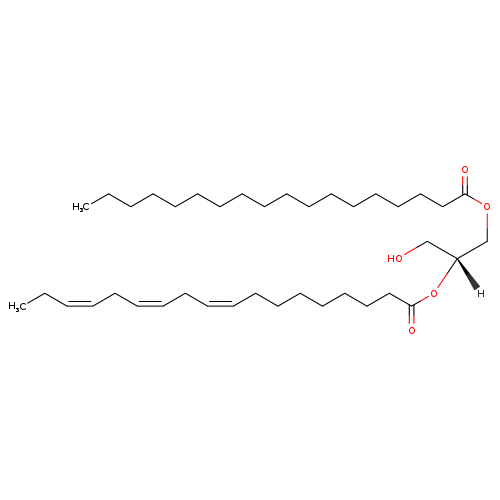
DescriptionDG(18:0/18:3(9Z,12Z,15Z)/0:0), also known as diacylglycerol or DAG(18:0/18:3), belongs to the class of organic compounds known as lineolic acids and derivatives. These are derivatives of lineolic acid. Lineolic acid is a polyunsaturated omega-6 18 carbon long fatty acid, with two CC double bonds at the 9- and 12-positions. Thus, DG(18:0/18:3(9Z,12Z,15Z)/0:0) is considered to be a diradylglycerol lipid molecule. DG(18:0/18:3(9Z,12Z,15Z)/0:0) is a very hydrophobic molecule, practically insoluble (in water), and relatively neutral. DG(18:0/18:3(9Z,12Z,15Z)/0:0) participates in a number of enzymatic reactions, within cattle. In particular, DG(18:0/18:3(9Z,12Z,15Z)/0:0) can be biosynthesized from PA(18:0/18:3(9Z,12Z,15Z)) through its interaction with the enzyme phosphatidate phosphatase. Furthermore, DG(18:0/18:3(9Z,12Z,15Z)/0:0) and eicosadienoyl-CoA can be converted into TG(18:0/18:3(9Z,12Z,15Z)/20:2(11Z,14Z)) through its interaction with the enzyme diacylglycerol O-acyltransferase. Furthermore, DG(18:0/18:3(9Z,12Z,15Z)/0:0) can be biosynthesized from PA(18:0/18:3(9Z,12Z,15Z)); which is mediated by the enzyme phosphatidate phosphatase. Furthermore, DG(18:0/18:3(9Z,12Z,15Z)/0:0) and erucoyl-CoA can be converted into TG(18:0/18:3(9Z,12Z,15Z)/22:1(13Z)) through the action of the enzyme diacylglycerol O-acyltransferase. Furthermore, DG(18:0/18:3(9Z,12Z,15Z)/0:0) can be biosynthesized from PA(18:0/18:3(9Z,12Z,15Z)) through the action of the enzyme phosphatidate phosphatase. Finally, DG(18:0/18:3(9Z,12Z,15Z)/0:0) and docosahexaenoyl-CoA can be converted into TG(18:0/18:3(9Z,12Z,15Z)/22:6(4Z,7Z,10Z,13Z,16Z,19Z)) through its interaction with the enzyme diacylglycerol O-acyltransferase. In cattle, DG(18:0/18:3(9Z,12Z,15Z)/0:0) is involved in a few metabolic pathways, which include de novo triacylglycerol biosynthesis TG(18:0/18:3(9Z,12Z,15Z)/20:2(11Z,14Z)) pathway, de novo triacylglycerol biosynthesis TG(18:0/18:3(9Z,12Z,15Z)/22:1(13Z)) pathway, and de novo triacylglycerol biosynthesis TG(18:0/18:3(9Z,12Z,15Z)/22:6(4Z,7Z,10Z,13Z,16Z,19Z)) pathway.
Structure
Thumb
SynonymsNot Available
Chemical FormulaC39H70O5
Average Molecular Weight618.984
Monoisotopic Molecular Weight618.522325354
IUPAC Name(2R)-1-hydroxy-3-(octadecanoyloxy)propan-2-yl (9Z,12Z,15Z)-octadeca-9,12,15-trienoate
Traditional Name(2R)-1-hydroxy-3-(octadecanoyloxy)propan-2-yl (9Z,12Z,15Z)-octadeca-9,12,15-trienoate
CAS Registry NumberNot Available
SMILES
[H][C@@](CO)(COC(=O)CCCCCCCCCCCCCCCCC)OC(=O)CCCCCCC\C=C/C\C=C/C\C=C/CC
InChI Identifier
InChI=1S/C39H70O5/c1-3-5-7-9-11-13-15-17-19-21-23-25-27-29-31-33-38(41)43-36-37(35-40)44-39(42)34-32-30-28-26-24-22-20-18-16-14-12-10-8-6-4-2/h6,8,12,14,18,20,37,40H,3-5,7,9-11,13,15-17,19,21-36H2,1-2H3/b8-6-,14-12-,20-18-/t37-/m1/s1
InChI KeyUBECYQFWKVVULW-JTIFTRAISA-N
Chemical Taxonomy
Description belongs to the class of organic compounds known as lineolic acids and derivatives. These are derivatives of lineolic acid. Lineolic acid is a polyunsaturated omega-6 18 carbon long fatty acid, with two CC double bonds at the 9- and 12-positions.
KingdomOrganic compounds
Super ClassLipids and lipid-like molecules
ClassFatty Acyls
Sub ClassLineolic acids and derivatives
Direct ParentLineolic acids and derivatives
Alternative Parents
Substituents
  • Octadecanoid
  • 1,2-acyl-sn-glycerol
  • Diacylglycerol
  • Diradylglycerol
  • Fatty acid ester
  • Glycerolipid
  • Dicarboxylic acid or derivatives
  • Carboxylic acid ester
  • Carboxylic acid derivative
  • Organooxygen compound
  • Hydrocarbon derivative
  • Organic oxygen compound
  • Organic oxide
  • Carbonyl group
  • Primary alcohol
  • Alcohol
  • Aliphatic acyclic compound
Molecular FrameworkAliphatic acyclic compounds
External DescriptorsNot Available
Ontology
StatusDetected and Quantified
Origin
  • Endogenous
  • Exogenous
BiofunctionNot Available
ApplicationNot Available
Cellular locations
  • Cell membrane
  • Cytoplasm
  • Membrane
Physical Properties
StateNot Available
Experimental Properties
PropertyValueReference
Melting PointNot AvailableNot Available
Boiling PointNot AvailableNot Available
Water SolubilityNot AvailableNot Available
LogPNot AvailableNot Available
Predicted Properties
PropertyValueSource
logP10.12ALOGPS
logP12.7ChemAxon
logS-7.7ALOGPS
pKa (Strongest Acidic)14.58ChemAxon
pKa (Strongest Basic)-3ChemAxon
Physiological Charge0ChemAxon
Hydrogen Acceptor Count3ChemAxon
Hydrogen Donor Count1ChemAxon
Polar Surface Area72.83 ŲChemAxon
Rotatable Bond Count35ChemAxon
Refractivity189.45 m³·mol⁻¹ChemAxon
Polarizability80.36 ųChemAxon
Number of Rings0ChemAxon
BioavailabilityYesChemAxon
Rule of FiveYesChemAxon
Ghose FilterYesChemAxon
Veber's RuleYesChemAxon
MDDR-like RuleYesChemAxon
Spectra
Spectra
Spectrum TypeDescriptionSplash Key
Predicted LC-MS/MSPredicted LC-MS/MS Spectrum - 10V, Positivesplash10-014i-1059005000-d9230e8213f8dc3e71b4View in MoNA
Predicted LC-MS/MSPredicted LC-MS/MS Spectrum - 20V, Positivesplash10-0173-3097021000-7d4f0dbdfe76ff17b168View in MoNA
Predicted LC-MS/MSPredicted LC-MS/MS Spectrum - 40V, Positivesplash10-00p0-2093020000-7391b496ac4cf0cfcf21View in MoNA
Predicted LC-MS/MSPredicted LC-MS/MS Spectrum - 10V, Negativesplash10-0159-0093003000-e2209f47b968cce40747View in MoNA
Predicted LC-MS/MSPredicted LC-MS/MS Spectrum - 20V, Negativesplash10-001i-1092000000-ab71108baa8608b1d703View in MoNA
Predicted LC-MS/MSPredicted LC-MS/MS Spectrum - 40V, Negativesplash10-001i-2090000000-01845428f87ba70fa6edView in MoNA
Biological Properties
Cellular Locations
  • Cell membrane
  • Cytoplasm
  • Membrane
Biospecimen Locations
  • Milk
Pathways
Normal Concentrations
BiospecimenStatusValueAgeSexConditionReferenceDetails
MilkDetected and Quantified12.9 +/- 0.2 uMNot SpecifiedNot Specified
Normal
details
MilkDetected and Quantified32 +/- 3 uMNot SpecifiedNot Specified
Normal
details
MilkDetected and Quantified69 +/- 1 uMNot SpecifiedNot Specified
Normal
details
MilkDetected and Quantified1.16 +/- 0.1 uMNot SpecifiedNot Specified
Normal
details
Abnormal Concentrations
Not Available
HMDB IDNot Available
DrugBank IDNot Available
Phenol Explorer Compound IDNot Available
FooDB IDNot Available
KNApSAcK IDNot Available
Chemspider IDNot Available
KEGG Compound IDNot Available
BioCyc IDNot Available
BiGG IDNot Available
Wikipedia LinkNot Available
METLIN IDNot Available
PubChem Compound102272272
PDB IDNot Available
ChEBI IDNot Available
References
Synthesis ReferenceNot Available
Material Safety Data Sheet (MSDS)Not Available
General References
  1. A. Foroutan et al. (2019). A. Foroutan et al. The Chemical Composition of Commercial Cow's Milk (in preparation). Journal of Agricultural and Food Chemistry.