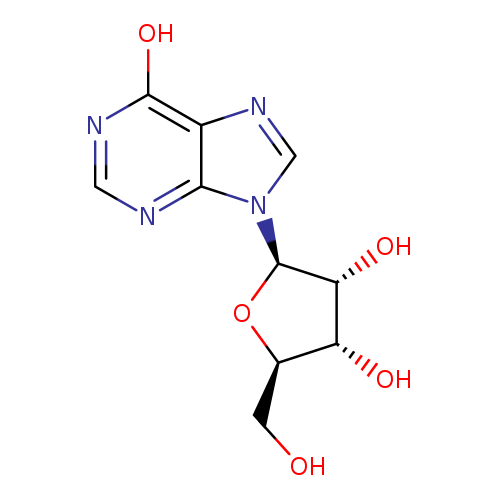
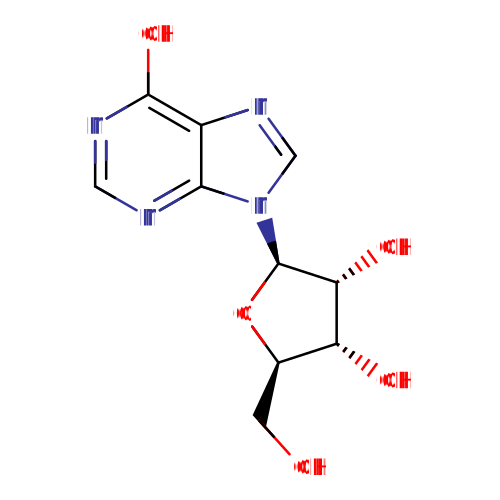
Inosine, also known as hypoxanthosine or panholic-L, belongs to the class of organic compounds known as purine nucleosides. Purine nucleosides are compounds comprising a purine base attached to a ribosyl or deoxyribosyl moiety. Inosine exists as a solid, possibly soluble (in water), and a moderately basic compound (based on its pKa) molecule. Inosine exists in all living species, ranging from bacteria to humans. Inosine is a potentially toxic compound.
belongs to the class of organic compounds known as purine nucleosides. Purine nucleosides are compounds comprising a purine base attached to a ribosyl or deoxyribosyl moiety.
The hubs mediating the relationships between intestinal microbiota and plasma metabolites were the intestinal bacterial genus g__norank_f__Eubacterium_coprostanoligenes_group, plasma inosine, triiodothyronine, and phosphorus, which could be used to differentiate cows’ hair coat status (P < 0.05).
A total of 88 metabolites was identified in the milk sample; just 9 metabolites (2-furoylglycine, 2-oxocaproate, arabinitol, glucarate, guanidinosuccinate, inosine, etc.) of them were identified in the milk sample (Fig 1 and S2 Table).
As shown in Figures 7A,B, five significantly differentially altered metabolites associated with pregnancy and attachment loss were identified and visualized using Sankey diagrams based on biological relevance and disease association analysis.
Written in the paper as “inosine” and “attachment loss”
Mirroring our results, research demonstrated lower purine metabolism and a diminished abundance of inosine in the serum of cows experiencing subclinical and clinical mastitis compared to their healthy counterparts (Wang et al., 2022).
Written in the paper as “inosine” and “clinical mastitis”
Mirroring our results, research demonstrated lower purine metabolism and a diminished abundance of inosine in the serum of cows experiencing subclinical and clinical mastitis compared to their healthy counterparts (Wang et al., 2022).
Written in the paper as “inosine” and “subclinical mastitis”
The chemical reactions and pathways involving purine nucleobases, one of the two classes of nitrogen-containing ring compounds found in DNA and RNA, which include adenine and guanine.
The plasma metabolome constitutes pathways for purine metabolism (inosine and uric acid), cysteine and methionine metabolism (1-aminocyclopropane-1-carboxylic acid and o-acetylserine), and histidine metabolism (urocanic acid and carnosine).
Written in the paper as “inosine” and “purine metabolism”
In addition, the study found some similarities between feces and serum metabolites of cows with mastitis; SCM and CM cows had higher levels of pro-inflammatory lipid products (20-trihydroxy-leukotriene-B4, 13,14-dihydro-15-keto-PGE2, 9,10-dihydroxylinoleic acids) and lower levels of metabolites involved in secondary bile acid metabolism (deoxycholic acid, 12-ketolithocholic acid), energy metabolism (3-hydroxyisovalerylcarnitine, citric acid), and purine metabolism (uric acid and inosine) [101].
Written in the paper as “inosine” and “purine metabolism”
Inosine is an endogenous purine nucleoside formed by the deamination of adenosine-by-adenosine deaminase and has been shown to have neuroprotective, anti-inflammatory and antioxidant properties (Ruhal Dhingra, 2018).
Written in the paper as “Inosine” and “deamination of adenosine”
In a recent report, inosine has been linked with a contributing role in energy expenditure within apoptotic brown adipocytes (Niemann et al., 2022).
Written in the paper as “inosine” and “energy expenditure”
Involved in
generation of precursor metabolites and energy GO:0006091
The chemical reactions and pathways resulting in the formation of precursor metabolites, substances from which energy is derived, and any process involved in the liberation of energy from these substances.
The chemical reactions and pathways involving a nucleotide, a nucleoside that is esterified with (ortho)phosphate or an oligophosphate at any hydroxyl group on the glycose moiety; may be mono-, di- or triphosphate; this definition includes cyclic nucleotides (nucleoside cyclic phosphates).
The chemical reactions and pathways involving a purine nucleotide, a compound consisting of nucleoside (a purine base linked to a deoxyribose or ribose sugar) esterified with a phosphate group at either the 3' or 5'-hydroxyl group of the sugar.
A total of five metabolites—guanosine, inosine, thymidine, butyryl-l-carnitine, and l-carnitine—were associated with attachment and pregnancy loss and could serve as predictors of fertility.
Written in the paper as “inosine” and “pregnancy loss”
Furthermore, it was discovered that the content of nucleotide metabolites such as ATP, ADP, inosine, and hypoxanthine was significantly elevated in the muscles of the high-tenderness group.
Written in the paper as “inosine” and “tenderness”
A macroscopic, multicellular, marine algae (kingdom Protista) that belongs to one of several groups of multicellular algae: the red algae, green algae, and brown algae. As these three groups are not thought to have a common multicellular ancestor, the seaweeds are a polyphyletic group. In addition, some tuft-forming bluegreen algae (Cyanobacteria) are sometimes considered seaweed.
Shi, Qingshan; Qiu, Yutang; Li, Liangqiu; Lin, Xiaoping. New inosine-producing bacterium and method for producing inosine. Faming Zhuanli Shenqing Gongkai Shuomingshu (2003), 6 pp.
Material Safety Data Sheet (MSDS)
Not Available
General References
Schlimme E, Raezke KP, Ott FG: Ribonucleosides as minor milk constituents. Z Ernahrungswiss. 1991 Jun;30(2):138-52. [PubMed:1897275 ]
Schlimme E, Martin D, Meisel H: Nucleosides and nucleotides: natural bioactive substances in milk and colostrum. Br J Nutr. 2000 Nov;84 Suppl 1:S59-68. [PubMed:11242448 ]
May have a critical role in the maintenance of a constant composition of intracellular purine/pyrimidine nucleotides in cooperation with other nucleotidases. Preferentially hydrolyzes inosine 5'-monophosphate (IMP) and other purine nucleotides.
The purine nucleoside phosphorylases catalyze the phosphorolytic breakdown of the N-glycosidic bond in the beta-(deoxy)ribonucleoside molecules, with the formation of the corresponding free purine bases and pentose-1-phosphate.
Catalyzes the hydrolytic deamination of adenosine and 2-deoxyadenosine (By similarity). Plays an important role in purine metabolism and in adenosine homeostasis (By similarity). Modulates signaling by extracellular adenosine, and so contributes indirectly to cellular signaling events (By similarity). Acts as a positive regulator of T-cell coactivation, by binding DPP4 (By similarity). Its interaction with DPP4 regulates lymphocyte-epithelial cell adhesion (By similarity). Enhances dendritic cell immunogenicity by affecting dendritic cell costimulatory molecule expression and cytokines and chemokines secretion (PubMed:23240012). Enhances CD4+ T-cell differentiation and proliferation (By similarity). Acts as a positive modulator of adenosine receptors ADORA1 and ADORA2A, by enhancing their ligand affinity via conformational change (By similarity). Stimulates plasminogen activation (By similarity). Plays a role in male fertility (By similarity). Plays a protective role in early postimplantation embryonic development (By similarity).