Record Information
Version1.0
Creation Date2016-09-30 22:36:42 UTC
Update Date2020-05-21 16:28:37 UTC
BMDB IDBMDB0000795
Secondary Accession Numbers
  • BMDB00795
Metabolite Identification
Common NamePristanic acid
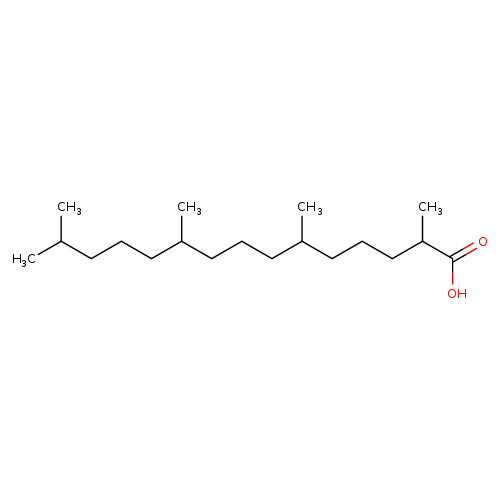
DescriptionPristanic acid, also known as pristanic acid or pristanic acid, belongs to the class of organic compounds known as acyclic diterpenoids. These are diterpenoids (compounds made of four consecutive isoprene units) that do not contain a cycle. Pristanic acid is a very hydrophobic molecule, practically insoluble (in water), and relatively neutral. Pristanic acid can be biosynthesized from pristanal through its interaction with the enzyme fatty aldehyde dehydrogenase. In cattle, pristanic acid is involved in the metabolic pathway called the phytanic Acid peroxisomal oxidation pathway.
Structure
Thumb
Synonyms
ValueSource
2,6,10,14-Tetramethyl-pentadecansaeureChEBI
2,6,10,14-Tetramethylpentadecylic acidChEBI
Acide pristaniqueChEBI
Acido pristanicoChEBI
PristaninsaeureChEBI
2,6,10,14-TetramethylpentadecylateGenerator
PristanateGenerator
(2S)-Pristanic acidHMDB
(2S,6R,10R)-2,6,10,14-TetramethylpentadecanoateHMDB
(2S,6R,10R)-2,6,10,14-Tetramethylpentadecanoic acidHMDB
(2S,6R,10R)-Pristanic acidHMDB
2,6,10,14-TetramethylpentadecanoateHMDB
2,6,10,14-Tetramethylpentadecanoic acidHMDB
Pristanate:(2S,6R,10R)-pristanateHMDB
Chemical FormulaC19H38O2
Average Molecular Weight298.511
Monoisotopic Molecular Weight298.287180464
IUPAC Name2,6,10,14-tetramethylpentadecanoic acid
Traditional Namepristanic acid
CAS Registry Number1189-37-3
SMILES
CC(C)CCCC(C)CCCC(C)CCCC(C)C(O)=O
InChI Identifier
InChI=1S/C19H38O2/c1-15(2)9-6-10-16(3)11-7-12-17(4)13-8-14-18(5)19(20)21/h15-18H,6-14H2,1-5H3,(H,20,21)
InChI KeyPAHGJZDQXIOYTH-UHFFFAOYSA-N
Chemical Taxonomy
Description belongs to the class of organic compounds known as acyclic diterpenoids. These are diterpenoids (compounds made of four consecutive isoprene units) that do not contain a cycle.
KingdomOrganic compounds
Super ClassLipids and lipid-like molecules
ClassPrenol lipids
Sub ClassDiterpenoids
Direct ParentAcyclic diterpenoids
Alternative Parents
Substituents
  • Acyclic diterpenoid
  • Long-chain fatty acid
  • Methyl-branched fatty acid
  • Branched fatty acid
  • Fatty acyl
  • Fatty acid
  • Monocarboxylic acid or derivatives
  • Carboxylic acid
  • Carboxylic acid derivative
  • Organic oxygen compound
  • Organic oxide
  • Hydrocarbon derivative
  • Organooxygen compound
  • Carbonyl group
  • Aliphatic acyclic compound
Molecular FrameworkAliphatic acyclic compounds
External Descriptors
Ontology
StatusExpected but not Quantified
Origin
  • Endogenous
  • Exogenous
BiofunctionNot Available
ApplicationNot Available
Cellular locations
  • Cell membrane
  • Cytoplasm
  • Membrane
  • Myelin sheath
  • Peroxisome
Physical Properties
StateSolid
Experimental Properties
PropertyValueReference
Melting PointNot AvailableNot Available
Boiling PointNot AvailableNot Available
Water SolubilityNot AvailableNot Available
LogPNot AvailableNot Available
Predicted Properties
PropertyValueSource
logP6.9ALOGPS
logP7.22ChemAxon
logS-6.3ALOGPS
pKa (Strongest Acidic)5ChemAxon
Physiological Charge-1ChemAxon
Hydrogen Acceptor Count2ChemAxon
Hydrogen Donor Count1ChemAxon
Polar Surface Area37.3 ŲChemAxon
Rotatable Bond Count13ChemAxon
Refractivity90.7 m³·mol⁻¹ChemAxon
Polarizability38.82 ųChemAxon
Number of Rings0ChemAxon
BioavailabilityYesChemAxon
Rule of FiveYesChemAxon
Ghose FilterYesChemAxon
Veber's RuleYesChemAxon
MDDR-like RuleYesChemAxon
Spectra
Spectra
Spectrum TypeDescriptionSplash Key
Predicted GC-MSPredicted GC-MS Spectrum - GC-MS (Non-derivatized) - 70eV, Positivesplash10-0006-9870000000-f2a1fccf594927bf2658View in MoNA
Predicted GC-MSPredicted GC-MS Spectrum - GC-MS (1 TMS) - 70eV, Positivesplash10-05g0-9432000000-dff09e9ff5d30894796aView in MoNA
Predicted GC-MSPredicted GC-MS Spectrum - GC-MS (Non-derivatized) - 70eV, PositiveNot AvailableView in JSpectraViewer
Predicted GC-MSPredicted GC-MS Spectrum - GC-MS (TBDMS_1_1) - 70eV, PositiveNot AvailableView in JSpectraViewer
LC-MS/MSLC-MS/MS Spectrum - Quattro_QQQ 10V, Positive (Annotated)splash10-06si-4940000000-03beff6ee7e5712b0be3View in MoNA
LC-MS/MSLC-MS/MS Spectrum - Quattro_QQQ 25V, Positive (Annotated)splash10-052r-2900000000-257d1f0711d1a7f28338View in MoNA
LC-MS/MSLC-MS/MS Spectrum - Quattro_QQQ 40V, Positive (Annotated)splash10-00xr-5932000000-d9475b731502d4745a32View in MoNA
Predicted LC-MS/MSPredicted LC-MS/MS Spectrum - 10V, Positivesplash10-0002-0190000000-9f7f32c22384a93f6bdbView in MoNA
Predicted LC-MS/MSPredicted LC-MS/MS Spectrum - 20V, Positivesplash10-0kdj-6960000000-7187029bd8b4d1886bf6View in MoNA
Predicted LC-MS/MSPredicted LC-MS/MS Spectrum - 40V, Positivesplash10-0a6s-9810000000-051a9ebc7e20e03dd488View in MoNA
Predicted LC-MS/MSPredicted LC-MS/MS Spectrum - 10V, Negativesplash10-0002-0090000000-2e296a53a5e430402f60View in MoNA
Predicted LC-MS/MSPredicted LC-MS/MS Spectrum - 20V, Negativesplash10-0f6t-0090000000-ae75aba02491d467a13dView in MoNA
Predicted LC-MS/MSPredicted LC-MS/MS Spectrum - 40V, Negativesplash10-059i-9480000000-ef08cae03dc3995f91f5View in MoNA
Predicted LC-MS/MSPredicted LC-MS/MS Spectrum - 10V, Positivesplash10-0002-2290000000-23db43d16b6195905ddaView in MoNA
Predicted LC-MS/MSPredicted LC-MS/MS Spectrum - 20V, Positivesplash10-07li-9620000000-5c45c02dd25695e1c91bView in MoNA
Predicted LC-MS/MSPredicted LC-MS/MS Spectrum - 40V, Positivesplash10-0a4i-9000000000-be260050b449f341bc60View in MoNA
Predicted LC-MS/MSPredicted LC-MS/MS Spectrum - 10V, Negativesplash10-0002-0090000000-d78513c03955a860495dView in MoNA
Predicted LC-MS/MSPredicted LC-MS/MS Spectrum - 20V, Negativesplash10-0002-0090000000-b72f0143bca09dec99f9View in MoNA
Predicted LC-MS/MSPredicted LC-MS/MS Spectrum - 40V, Negativesplash10-0007-7690000000-4162e1382b3a0cd64736View in MoNA
1D NMR13C NMR Spectrum (1D, 100 MHz, H2O, predicted)Not AvailableView in JSpectraViewer
1D NMR1H NMR Spectrum (1D, 100 MHz, H2O, predicted)Not AvailableView in JSpectraViewer
1D NMR13C NMR Spectrum (1D, 1000 MHz, H2O, predicted)Not AvailableView in JSpectraViewer
1D NMR1H NMR Spectrum (1D, 1000 MHz, H2O, predicted)Not AvailableView in JSpectraViewer
1D NMR13C NMR Spectrum (1D, 200 MHz, H2O, predicted)Not AvailableView in JSpectraViewer
1D NMR1H NMR Spectrum (1D, 200 MHz, H2O, predicted)Not AvailableView in JSpectraViewer
1D NMR13C NMR Spectrum (1D, 300 MHz, H2O, predicted)Not AvailableView in JSpectraViewer
1D NMR1H NMR Spectrum (1D, 300 MHz, H2O, predicted)Not AvailableView in JSpectraViewer
1D NMR13C NMR Spectrum (1D, 400 MHz, H2O, predicted)Not AvailableView in JSpectraViewer
1D NMR1H NMR Spectrum (1D, 400 MHz, H2O, predicted)Not AvailableView in JSpectraViewer
1D NMR13C NMR Spectrum (1D, 500 MHz, H2O, predicted)Not AvailableView in JSpectraViewer
1D NMR1H NMR Spectrum (1D, 500 MHz, H2O, predicted)Not AvailableView in JSpectraViewer
1D NMR13C NMR Spectrum (1D, 600 MHz, H2O, predicted)Not AvailableView in JSpectraViewer
1D NMR1H NMR Spectrum (1D, 600 MHz, H2O, predicted)Not AvailableView in JSpectraViewer
1D NMR13C NMR Spectrum (1D, 700 MHz, H2O, predicted)Not AvailableView in JSpectraViewer
1D NMR1H NMR Spectrum (1D, 700 MHz, H2O, predicted)Not AvailableView in JSpectraViewer
1D NMR13C NMR Spectrum (1D, 800 MHz, H2O, predicted)Not AvailableView in JSpectraViewer
1D NMR1H NMR Spectrum (1D, 800 MHz, H2O, predicted)Not AvailableView in JSpectraViewer
1D NMR13C NMR Spectrum (1D, 900 MHz, H2O, predicted)Not AvailableView in JSpectraViewer
1D NMR1H NMR Spectrum (1D, 900 MHz, H2O, predicted)Not AvailableView in JSpectraViewer
Biological Properties
Cellular Locations
  • Cell membrane
  • Cytoplasm
  • Membrane
  • Myelin sheath
  • Peroxisome
Biospecimen Locations
  • Fibroblasts
  • Neuron
  • Prostate Tissue
Pathways
Normal Concentrations
BiospecimenStatusValueAgeSexConditionReferenceDetails
FibroblastsExpected but not QuantifiedNot QuantifiedNot SpecifiedNot SpecifiedNormal
  • Not Applicable
details
NeuronExpected but not QuantifiedNot QuantifiedNot SpecifiedNot SpecifiedNormal
  • Not Applicable
details
Prostate TissueExpected but not QuantifiedNot QuantifiedNot SpecifiedNot SpecifiedNormal
  • Not Applicable
details
Abnormal Concentrations
Not Available
HMDB IDHMDB0000795
DrugBank IDNot Available
Phenol Explorer Compound IDNot Available
FooDB IDFDB012993
KNApSAcK IDNot Available
Chemspider ID110458
KEGG Compound IDNot Available
BioCyc IDPRISTANATE
BiGG ID2364527
Wikipedia LinkPristanic acid
METLIN ID5760
PubChem Compound123929
PDB IDNot Available
ChEBI ID51340
References
Synthesis ReferenceNakajima, Kenji; Sato, Akio. Microbial oxidation of isoprenoid hydrocarbons. Part II. Production of pristanol and pristanic acid from pristane by Nocardia sp. BPM 1613. Nippon Nogei Kagaku Kaishi (1981), 55(9), 825-8.
Material Safety Data Sheet (MSDS)Not Available
General ReferencesNot Available

Enzymes

General function:
Energy production and conversion
Specific function:
Oxidizes medium and long chain saturated and unsaturated aldehydes. Metabolizes also benzaldehyde. Low activity towards acetaldehyde and 3,4-dihydroxyphenylacetaldehyde. May not metabolize short chain aldehydes. Can use both NADP(+) and NAD(+) as electron acceptor. May have a protective role against the cytotoxicity induced by lipid peroxidation.
Gene Name:
ALDH3B1
Uniprot ID:
Q1JPA0
Molecular weight:
51800.0
Reactions
Pristanal + NAD + Water → Pristanic acid + NADHdetails