| Record Information |
|---|
| Version | 1.0 |
|---|
| Creation Date | 2016-09-30 22:40:21 UTC |
|---|
| Update Date | 2020-05-19 22:01:06 UTC |
|---|
| BMDB ID | BMDB0001047 |
|---|
| Secondary Accession Numbers | |
|---|
| Metabolite Identification |
|---|
| Common Name | D-Fructose 2,6-bisphosphate |
|---|
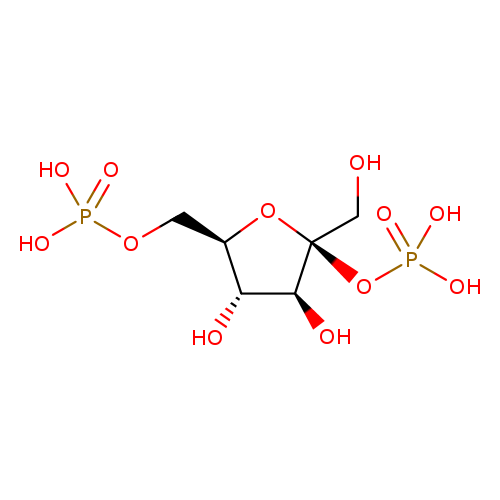
| Description | D-D-d-fructose 2,6-bisphosphate, also known as d-fructose 2,6-bisphosphate, belongs to the class of organic compounds known as pentose phosphates. These are carbohydrate derivatives containing a pentose substituted by one or more phosphate groups. D-D-d-fructose 2,6-bisphosphate is possibly soluble (in water) and an extremely weak basic (essentially neutral) compound (based on its pKa). D-D-d-fructose 2,6-bisphosphate exists in all living species, ranging from bacteria to humans. D-D-d-fructose 2,6-bisphosphate can be converted into fructose 6-phosphate; which is mediated by the enzyme 6-phosphofructo-2-kinase/fructose-2,6-bisphosphatase 1. In cattle, D-d-fructose 2,6-bisphosphate is involved in the metabolic pathway called the fructose and mannose degradation pathway. |
|---|
| Structure | |
|---|
| Synonyms | | Value | Source |
|---|
| 2,6-Di-O-phosphono-beta-D-fructofuranose | ChEBI | | 2,6-Di-O-phosphono-b-D-fructofuranose | Generator | | 2,6-Di-O-phosphono-β-D-fructofuranose | Generator | | D-Fructose 2,6-bisphosphoric acid | Generator | | b-D-Fructose 2,6-bisphosphate | HMDB | | beta-D-Fructose 2,6-bisphosphate | HMDB | | Fru 2,6-P2, fructose 2,6-diphosphate | HMDB | | Fructose 2,6-bisphosphate | HMDB | | Fructose 2,6-biphosphate | MeSH, HMDB | | Fructose 2,6-diphosphate | MeSH, HMDB | | Phosphofructokinase activation factor | MeSH, HMDB | | Phosphofructokinase activator | MeSH, HMDB | | Fructose-2,6-diphosphate | MeSH, HMDB | | D-Fructose 2,6-diphosphate | HMDB | | beta-D-Fructose 2,6-diphosphate | HMDB | | β-D-Fructose 2,6-diphosphate | HMDB |
|
|---|
| Chemical Formula | C6H14O12P2 |
|---|
| Average Molecular Weight | 340.1157 |
|---|
| Monoisotopic Molecular Weight | 339.996048936 |
|---|
| IUPAC Name | {[(2R,3S,4S,5S)-3,4-dihydroxy-5-(hydroxymethyl)-5-(phosphonooxy)oxolan-2-yl]methoxy}phosphonic acid |
|---|
| Traditional Name | fructose-2,6-diphosphate |
|---|
| CAS Registry Number | 79082-92-1 |
|---|
| SMILES | OC[C@@]1(OP(O)(O)=O)O[C@H](COP(O)(O)=O)[C@@H](O)[C@@H]1O |
|---|
| InChI Identifier | InChI=1S/C6H14O12P2/c7-2-6(18-20(13,14)15)5(9)4(8)3(17-6)1-16-19(10,11)12/h3-5,7-9H,1-2H2,(H2,10,11,12)(H2,13,14,15)/t3-,4-,5+,6+/m1/s1 |
|---|
| InChI Key | YXWOAJXNVLXPMU-ZXXMMSQZSA-N |
|---|
| Chemical Taxonomy |
|---|
| Description | belongs to the class of organic compounds known as pentose phosphates. These are carbohydrate derivatives containing a pentose substituted by one or more phosphate groups. |
|---|
| Kingdom | Organic compounds |
|---|
| Super Class | Organic oxygen compounds |
|---|
| Class | Organooxygen compounds |
|---|
| Sub Class | Carbohydrates and carbohydrate conjugates |
|---|
| Direct Parent | Pentose phosphates |
|---|
| Alternative Parents | |
|---|
| Substituents | - Pentose phosphate
- Pentose-5-phosphate
- C-glycosyl compound
- Glycosyl compound
- Monosaccharide phosphate
- Monoalkyl phosphate
- Phosphoric acid ester
- Organic phosphoric acid derivative
- Alkyl phosphate
- Tetrahydrofuran
- Secondary alcohol
- Organoheterocyclic compound
- Oxacycle
- Primary alcohol
- Alcohol
- Hydrocarbon derivative
- Organic oxide
- Aliphatic heteromonocyclic compound
|
|---|
| Molecular Framework | Aliphatic heteromonocyclic compounds |
|---|
| External Descriptors | |
|---|
| Ontology |
|---|
| Status | Expected but not Quantified |
|---|
| Origin | |
|---|
| Biofunction | Not Available |
|---|
| Application | Not Available |
|---|
| Cellular locations | |
|---|
| Physical Properties |
|---|
| State | Solid |
|---|
| Experimental Properties | | Property | Value | Reference |
|---|
| Melting Point | Not Available | Not Available | | Boiling Point | Not Available | Not Available | | Water Solubility | Not Available | Not Available | | LogP | Not Available | Not Available |
|
|---|
| Predicted Properties | |
|---|
| Spectra |
|---|
| Spectra | |
|---|
| Synthesis Reference | Shulman, Hagit; Makarov, Carina; Ogawa, Anthony K.; Romesberg, Floyd; Keinan, Ehud. Chemically Reactive Immunogens Lead to Functional Convergence of the Immune Response. Journal of the American Chemical Society (2000), 122(44), 10743-10753. |
|---|