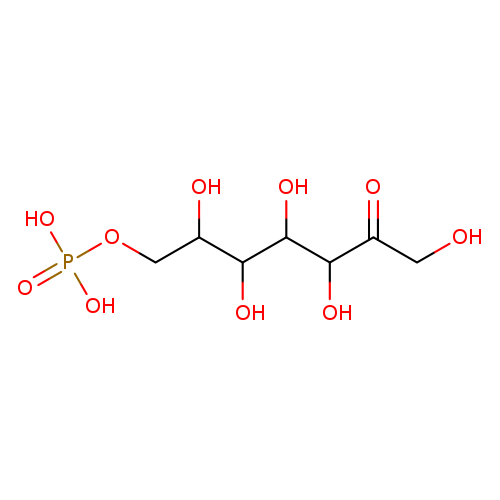
D-D-d-sedoheptulose 7-phosphate, also known as D-sedoheptulose-7-P, belongs to the class of organic compounds known as hexose phosphates. These are carbohydrate derivatives containing a hexose substituted by one or more phosphate groups. D-D-d-sedoheptulose 7-phosphate is possibly soluble (in water) and an extremely weak basic (essentially neutral) compound (based on its pKa). D-D-d-sedoheptulose 7-phosphate exists in all eukaryotes, ranging from yeast to humans. D-D-d-sedoheptulose 7-phosphate participates in a number of enzymatic reactions, within cattle. In particular, D-Glyceraldehyde 3-phosphate and D-d-sedoheptulose 7-phosphate can be converted into D-ribose 5-phosphate and xylulose 5-phosphate through its interaction with the enzyme transketolase. Furthermore, D-Glyceraldehyde 3-phosphate and D-d-sedoheptulose 7-phosphate can be biosynthesized from D-erythrose 4-phosphate and fructose 6-phosphate; which is mediated by the enzyme transaldolase. Furthermore, D-Glyceraldehyde 3-phosphate and D-d-sedoheptulose 7-phosphate can be biosynthesized from D-erythrose 4-phosphate and fructose 6-phosphate through its interaction with the enzyme transaldolase. Finally, D-Glyceraldehyde 3-phosphate and D-d-sedoheptulose 7-phosphate can be converted into D-ribose 5-phosphate and xylulose 5-phosphate; which is catalyzed by the enzyme transketolase. In cattle, D-d-sedoheptulose 7-phosphate is involved in a couple of metabolic pathways, which include the pentose phosphate pathway and cancer (via the Warburg effect).
belongs to the class of organic compounds known as monosaccharide phosphates. These are monosaccharides comprising a phosphated group linked to the carbohydrate unit.
In PARL samples, a total of 1061 taxa were found to be contributing to the variation of four metabolites, including succinate and sedoheptulose 7-phosphate (Supplementary Table S6).
Written in the paper as “sedoheptulose 7-phosphate” and “particle associated rumen liquid”
These findings strongly indicate that T. gondii SBPase drives carbon into S7P where it can flow into either ribose-5-phosphate and nucleotide metabolism or down the non-oxidative PPP and back into glycolysis.
Written in the paper as “sedoheptulose-7-phosphate” and “non-oxidative phosphate pathway”
Sedoheptulose 7-phosphate is part of the pentose phosphate pathways associated with carbohydrate metabolism, as well as a fundamental element for LPS synthesis in Gram-negative bacteria (Taylor et al., 2008).
Written in the paper as “Sedoheptulose 7-phosphate” and “carbohydrate metabolism”
These results indicate that SBPase plays a similar role in S. cerevisiae and T. gondii metabolism, driving the synthesis of S7P which can then flow into ribose and nucleotide synthesis.
Written in the paper as “sedoheptulose-7-phosphate” and “ribose synthesis”
The chemical reactions and pathways resulting in the breakdown of a carbohydrate into pyruvate, with the concomitant production of a small amount of ATP and the reduction of NAD(P) to NAD(P)H. Glycolysis begins with the metabolism of a carbohydrate to generate products that can enter the pathway and ends with the production of pyruvate. Pyruvate may be converted to acetyl-coenzyme A, ethanol, lactate, or other small molecules.
These findings strongly indicate that T. gondii SBPase drives carbon into S7P where it can flow into either ribose-5-phosphate and nucleotide metabolism or down the non-oxidative PPP and back into glycolysis.
Written in the paper as “sedoheptulose-7-phosphate” and “glycolysis”
Involved in
lipopolysaccharide biosynthetic process GO:0009103
The chemical reactions and pathways resulting in the formation of lipopolysaccharides, any of a group of related, structurally complex components of the outer membrane of Gram-negative bacteria.
Sedoheptulose 7-phosphate is part of the pentose phosphate pathways associated with carbohydrate metabolism, as well as a fundamental element for LPS synthesis in Gram-negative bacteria (Taylor et al., 2008).
Written in the paper as “Sedoheptulose 7-phosphate” and “lipopolysaccharide synthesis”
The chemical reactions and pathways resulting in the formation of nucleotides, any nucleoside that is esterified with (ortho)phosphate or an oligophosphate at any hydroxyl group on the glycose moiety; may be mono-, di- or triphosphate; this definition includes cyclic-nucleotides (nucleoside cyclic phosphates).
These results indicate that SBPase plays a similar role in S. cerevisiae and T. gondii metabolism, driving the synthesis of S7P which can then flow into ribose and nucleotide synthesis.
Written in the paper as “sedoheptulose-7-phosphate” and “nucleotide synthesis”
The chemical reactions and pathways involving a nucleotide, a nucleoside that is esterified with (ortho)phosphate or an oligophosphate at any hydroxyl group on the glycose moiety; may be mono-, di- or triphosphate; this definition includes cyclic nucleotides (nucleoside cyclic phosphates).
These findings strongly indicate that T. gondii SBPase drives carbon into S7P where it can flow into either ribose-5-phosphate and nucleotide metabolism or down the non-oxidative PPP and back into glycolysis.
Written in the paper as “sedoheptulose-7-phosphate” and “nucleotide metabolism”
The metabolic process in which glucose-6-phosphate is oxidized to form carbon dioxide (CO2) and ribulose 5-phosphate, coupled to reduction of NADP+ to NADPH; ribulose 5-P then enters a series of reactions that can yield biosynthetic precursors (ribose-5-phosphate and erythrose-4-phosphate) and glycolytic intermediates (fructose-6-phosphate and glyceraldehyde-3-phosphate).
Sedoheptulose 7-phosphate is part of the pentose phosphate pathways associated with carbohydrate metabolism, as well as a fundamental element for LPS synthesis in Gram-negative bacteria (Taylor et al., 2008).
Written in the paper as “Sedoheptulose 7-phosphate” and “pentose phosphate pathways”
The last panel shows metabolites involved in the PPP, sedoheptulose-7-phosphate (S7P, red circles), sedoheptulose-1,7-bisphosphate SBP, blue squares) and octulose-8-phosphate (O8P, green triangles).
Written in the paper as “sedoheptulose-7-phosphate” and “phosphate pathway”
Produced by
spontaneous dephosphorylation of sedoheptulose-1,7-bisphosphate to sedoheptulose-7-phosphate
We reacted the synthesized SBP with lysate from the BFP and SBPase expressing HeLa cells, along with a no lysate control for spontaneous dephosphorylation of SBP to S7P (Fig 6B, S6 Fig).
Written in the paper as “sedoheptulose-7-phosphate” and “spontaneous dephosphorylation of sedoheptulose-1,7-bisphosphate to sedoheptulose-7-phosphate”
Catalyzes the transfer of a two-carbon ketol group from a ketose donor to an aldose acceptor, via a covalent intermediate with the cofactor thiamine pyrophosphate.
Plays an essential role in total transketolase activity and cell proliferation in cancer cells; after transfection with anti-TKTL1 siRNA, total transketolase activity dramatically decreases and proliferation was significantly inhibited in cancer cells. Plays a pivotal role in carcinogenesis (By similarity).
Catalyzes the transfer of a two-carbon ketol group from a ketose donor to an aldose acceptor, via a covalent intermediate with the cofactor thiamine pyrophosphate.