Record Information
Version1.0
Creation Date2016-09-30 22:51:48 UTC
Update Date2020-05-21 16:27:15 UTC
BMDB IDBMDB0002152
Secondary Accession Numbers
  • BMDB02152
Metabolite Identification
Common Name11-cis-Retinaldehyde
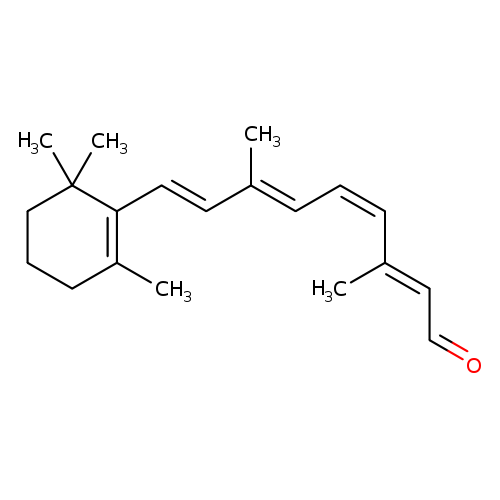
Description13-cis-13-cis-13-cis-retinal, also known as 13Z-13-cis-retinal or 13-cis-retinal, belongs to the class of organic compounds known as retinoids. These are oxygenated derivatives of 3,7-dimethyl-1-(2,6,6-trimethylcyclohex-1-enyl)nona-1,3,5,7-tetraene and derivatives thereof. Thus, 13-cis-13-cis-retinal is considered to be an isoprenoid lipid molecule. 13-cis-13-cis-13-cis-retinal is a very hydrophobic molecule, practically insoluble (in water), and relatively neutral. 13-cis-13-cis-13-cis-retinal exists in all living organisms, ranging from bacteria to humans. In cattle, 13-cis-13-cis-retinal is involved in the metabolic pathway called the retinol metabolism pathway.
Structure
Thumb
Synonyms
ValueSource
(2E,4Z,6E,8E)-3,7-Dimethyl-9-(2,6,6-trimethylcyclohex-1-en-1-yl)nona-2,4,6,8-tetraenalChEBI
11-cis-RetineneChEBI
11-cis-Vitamin a aldehydeChEBI
11-cis-RetinalHMDB
cis-11-RetinalHMDB
11 cis RetinalMeSH, HMDB
RetinaldehydeMeSH, HMDB
RetineneMeSH, HMDB
RetinalMeSH, HMDB
Aldehyde, vitamin aMeSH, HMDB
Vitamin a aldehydeMeSH, HMDB
AxerophthalMeSH, HMDB
Chemical FormulaC20H28O
Average Molecular Weight284.4357
Monoisotopic Molecular Weight284.214015518
IUPAC Name(2E,4Z,6E,8E)-3,7-dimethyl-9-(2,6,6-trimethylcyclohex-1-en-1-yl)nona-2,4,6,8-tetraenal
Traditional Name11-cis-retinal
CAS Registry Number564-87-4
SMILES
C/C(/C=C\C=C(/C)\C=C\C1=C(C)CCCC1(C)C)=C\C=O
InChI Identifier
InChI=1S/C20H28O/c1-16(8-6-9-17(2)13-15-21)11-12-19-18(3)10-7-14-20(19,4)5/h6,8-9,11-13,15H,7,10,14H2,1-5H3/b9-6-,12-11+,16-8+,17-13+
InChI KeyNCYCYZXNIZJOKI-IOUUIBBYSA-N
Chemical Taxonomy
Description belongs to the class of organic compounds known as retinoids. These are oxygenated derivatives of 3,7-dimethyl-1-(2,6,6-trimethylcyclohex-1-enyl)nona-1,3,5,7-tetraene and derivatives thereof.
KingdomOrganic compounds
Super ClassLipids and lipid-like molecules
ClassPrenol lipids
Sub ClassRetinoids
Direct ParentRetinoids
Alternative Parents
Substituents
  • Retinoid skeleton
  • Diterpenoid
  • Enal
  • Alpha,beta-unsaturated aldehyde
  • Organic oxygen compound
  • Organic oxide
  • Hydrocarbon derivative
  • Organooxygen compound
  • Carbonyl group
  • Aldehyde
  • Aliphatic homomonocyclic compound
Molecular FrameworkAliphatic homomonocyclic compounds
External Descriptors
Ontology
StatusExpected but not Quantified
Origin
  • Endogenous
  • Exogenous
BiofunctionNot Available
ApplicationNot Available
Cellular locations
  • Cell membrane
  • Cytoplasm
  • Membrane
Physical Properties
StateSolid
Experimental Properties
PropertyValueReference
Melting Point63.5 - 64.4 °CNot Available
Boiling PointNot AvailableNot Available
Water SolubilityNot AvailableNot Available
LogPNot AvailableNot Available
Predicted Properties
PropertyValueSource
logP6.62ALOGPS
logP4.86ChemAxon
logS-4.8ALOGPS
pKa (Strongest Basic)-4.1ChemAxon
Physiological Charge0ChemAxon
Hydrogen Acceptor Count1ChemAxon
Hydrogen Donor Count0ChemAxon
Polar Surface Area17.07 ŲChemAxon
Rotatable Bond Count5ChemAxon
Refractivity96.87 m³·mol⁻¹ChemAxon
Polarizability34.82 ųChemAxon
Number of Rings1ChemAxon
BioavailabilityYesChemAxon
Rule of FiveYesChemAxon
Ghose FilterYesChemAxon
Veber's RuleYesChemAxon
MDDR-like RuleYesChemAxon
Spectra
Spectra
Spectrum TypeDescriptionSplash Key
Predicted GC-MSPredicted GC-MS Spectrum - GC-MS (Non-derivatized) - 70eV, Positivesplash10-014i-2290000000-df9d2aa7545cc60a54f9View in MoNA
Predicted GC-MSPredicted GC-MS Spectrum - GC-MS (Non-derivatized) - 70eV, PositiveNot AvailableView in JSpectraViewer
Predicted LC-MS/MSPredicted LC-MS/MS Spectrum - 10V, Positivesplash10-000i-1490000000-97cddfba9819c3417386View in MoNA
Predicted LC-MS/MSPredicted LC-MS/MS Spectrum - 20V, Positivesplash10-001s-3920000000-0be8a19c3cba33e3b06bView in MoNA
Predicted LC-MS/MSPredicted LC-MS/MS Spectrum - 40V, Positivesplash10-0kui-9720000000-a579102a9f5600032e3fView in MoNA
Predicted LC-MS/MSPredicted LC-MS/MS Spectrum - 10V, Negativesplash10-001i-0090000000-e7d5d678e91ec531c2aeView in MoNA
Predicted LC-MS/MSPredicted LC-MS/MS Spectrum - 20V, Negativesplash10-0a59-0090000000-8af2668c966a1c8a3cefView in MoNA
Predicted LC-MS/MSPredicted LC-MS/MS Spectrum - 40V, Negativesplash10-00ku-3690000000-54506b9021b67caed041View in MoNA
Predicted LC-MS/MSPredicted LC-MS/MS Spectrum - 10V, Positivesplash10-00n3-1960000000-43f8c66f164764c37361View in MoNA
Predicted LC-MS/MSPredicted LC-MS/MS Spectrum - 20V, Positivesplash10-0609-3920000000-dbeab0a82b306761cf6aView in MoNA
Predicted LC-MS/MSPredicted LC-MS/MS Spectrum - 40V, Positivesplash10-052f-7900000000-d2bb7c1aeeb87d8833d2View in MoNA
Predicted LC-MS/MSPredicted LC-MS/MS Spectrum - 10V, Negativesplash10-0a59-0090000000-2ec2f8f314943441fa15View in MoNA
Predicted LC-MS/MSPredicted LC-MS/MS Spectrum - 20V, Negativesplash10-0pb9-0190000000-312cebb17ccd0189ab4dView in MoNA
Predicted LC-MS/MSPredicted LC-MS/MS Spectrum - 40V, Negativesplash10-000i-1590000000-b2551eac481c0c930a4dView in MoNA
1D NMR1H NMR Spectrum (1D, 600 MHz, CDCl3, experimental)Not AvailableView in JSpectraViewer
2D NMR[1H, 13C]-HSQC NMR Spectrum (2D, 600 MHz, CDCl3, experimental)Not AvailableView in JSpectraViewer
Biological Properties
Cellular Locations
  • Cell membrane
  • Cytoplasm
  • Membrane
Biospecimen Locations
  • Testis
Pathways
Normal Concentrations
BiospecimenStatusValueAgeSexConditionReferenceDetails
TestisExpected but not QuantifiedNot QuantifiedNot SpecifiedNot SpecifiedNormal
  • Not Applicable
details
Abnormal Concentrations
Not Available
HMDB IDHMDB0002152
DrugBank IDNot Available
Phenol Explorer Compound IDNot Available
FooDB IDFDB022871
KNApSAcK IDNot Available
Chemspider ID4444130
KEGG Compound IDC02110
BioCyc IDCPD-881
BiGG ID2265510
Wikipedia LinkNot Available
METLIN ID6513
PubChem Compound5280490
PDB IDNot Available
ChEBI ID16066
References
Synthesis ReferenceIto, Masayoshi; Wada, Akimori. Preparation of 11-cis-Retinal and their intermediates. Jpn. Kokai Tokkyo Koho (1998), 12 pp.
Material Safety Data Sheet (MSDS)Not Available
General ReferencesNot Available

Enzymes

General function:
Lipid transport and metabolism
Specific function:
Retinol dehydrogenase with a clear preference for NADP. Converts all-trans-retinal to all-trans-retinol. May play a role in the regeneration of visual pigment at high light intensity.
Gene Name:
RDH8
Uniprot ID:
Q9N126
Molecular weight:
33956.0
Reactions
11-cis-Retinaldehyde + NADP → Retinal + NADPHdetails
General function:
Energy production and conversion
Specific function:
Catalyzes the oxidation of long-chain primary alcohols and the oxidation of S-(hydroxymethyl) glutathione. Also oxidizes long chain omega-hydroxy fatty acids, such as 20-HETE, producing both the intermediate aldehyde, 20-oxoarachidonate and the end product, a dicarboxylic acid, (5Z,8Z,11Z,14Z)-eicosatetraenedioate. Class-III ADH is remarkably ineffective in oxidizing ethanol.
Gene Name:
ADH5
Uniprot ID:
Q3ZC42
Molecular weight:
39677.0
Reactions
11-cis-Retinaldehyde + NAD → Retinal + NADHdetails
General function:
Lipid transport and metabolism
Specific function:
Retinoids dehydrogenase/reductase with a clear preference for NADP. Displays high activity towards 9-cis, 11-cis and all-trans-retinal. Shows very weak activity towards 13-cis-retinol. Also exhibits activity, albeit with lower affinity than for retinaldehydes, towards lipid peroxidation products (C9 aldehydes) such as 4-hydroxynonenal and trans-2-nonenal. May play an important function in photoreceptor cells to detoxify 4-hydroxynonenal and potentially other toxic aldehyde products resulting from lipid peroxidation. Has no dehydrogenase activity towards steroids.
Gene Name:
RDH12
Uniprot ID:
P59837
Molecular weight:
35171.0
Reactions
11-cis-Retinaldehyde → Retinaldetails
11-cis-Retinaldehyde + NADP → 11-cis-Retinol + NADPHdetails
General function:
Involved in G-protein coupled receptor activity
Specific function:
Receptor for all-trans- and 11-cis-retinal. Binds preferentially to the former and may catalyze the isomerization of the chromophore by a retinochrome-like mechanism.
Gene Name:
RGR
Uniprot ID:
P47803
Molecular weight:
31961.0